Mine planning increasingly depends on the ability to combine geological information with operational and production data. Orebody models, grade estimates, equipment performance, processing constraints and changing site conditions all influence decisions about extraction sequences and production schedules. As these datasets become larger and more frequently updated, artificial intelligence is being used to identify patterns, generate predictions and support planning decisions.
This is giving AI mine planning a broader role across the mining value chain. Rather than relying solely on predefined assumptions and conventional optimisation techniques, planners can increasingly use machine learning models to process complex datasets and provide additional information about possible outcomes.
AI is Bringing More Data into Mine Planning
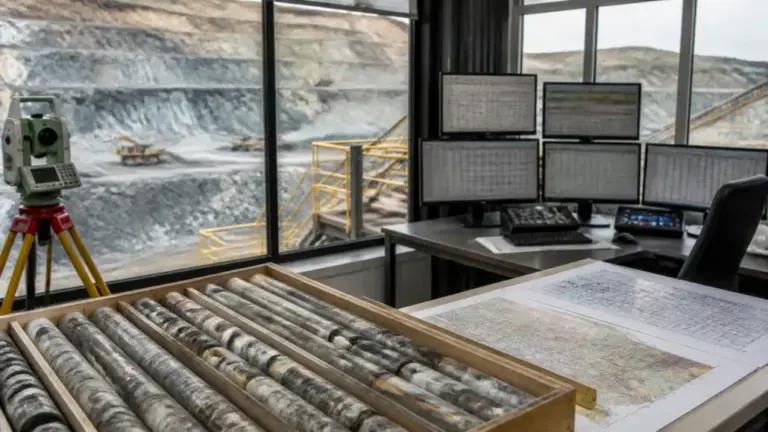
Geological information is one of the most important inputs. Resource estimation requires mining teams to interpret drilling, geological, geochemical and geophysical information before determining how an orebody may be extracted. Machine learning can process relationships within these datasets and assist with resource estimation or classification.
The same principle applies to operational information. Equipment utilisation, production rates, maintenance records and changing operating conditions can provide additional inputs for planning models. Bringing these datasets together can allow planners to assess proposed schedules against a wider range of real-world conditions rather than relying entirely on historical averages.
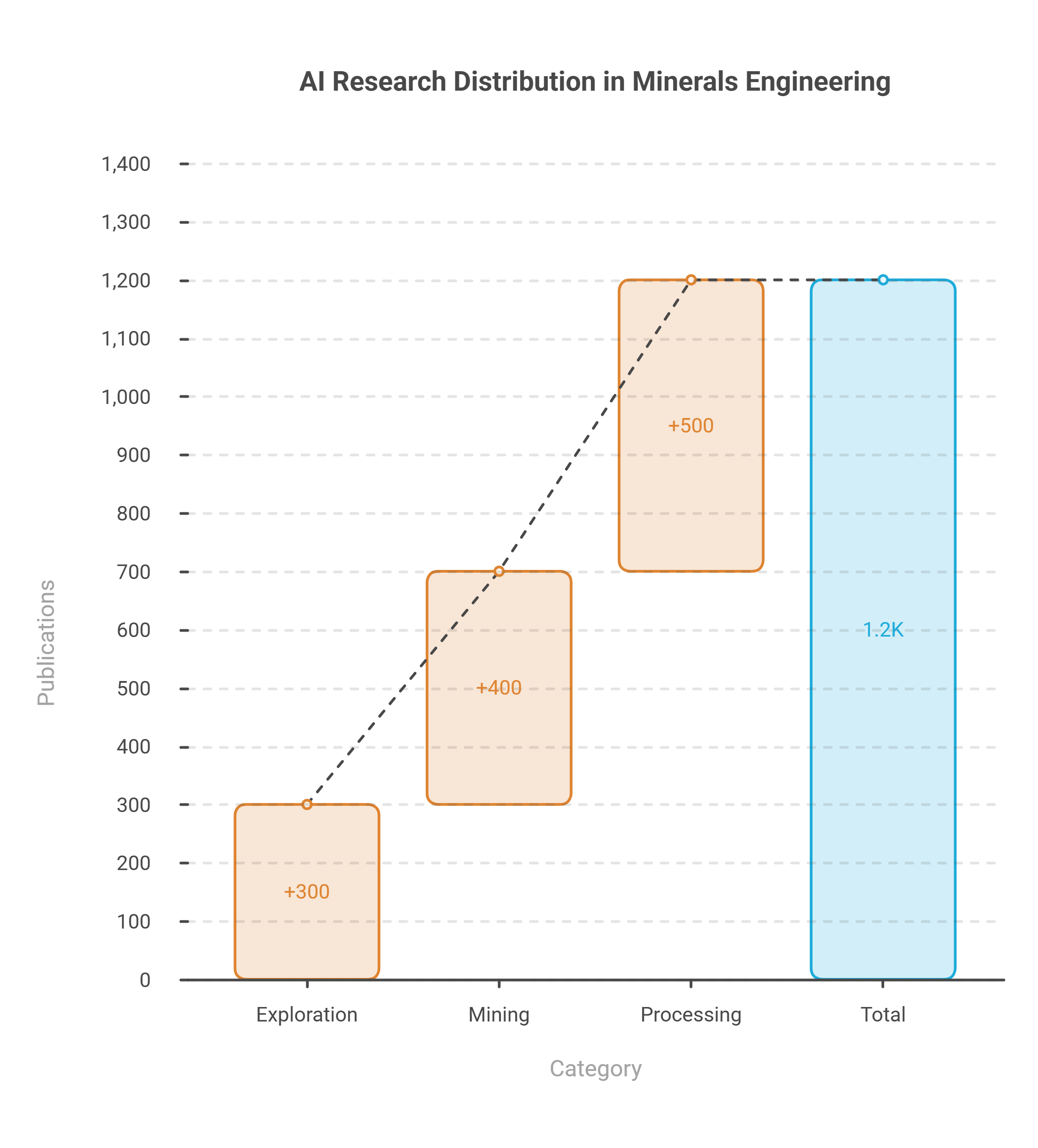
Recent research demonstrates the growing scale of interest. A 2025 bibliometric review analysed more than 1,200 publications examining artificial intelligence applications across minerals engineering, including mineral exploration, mining and mineral processing. The research identified applications spanning resource estimation, operational optimisation, safety and autonomous systems.
The growth in research does not mean that these applications have reached uniform commercial adoption. It does, however, show that AI is becoming an increasingly established area of research across the mining value chain. AI mine planning is part of this wider movement toward using more data-intensive methods to support technical and operational decisions.
From Geological Models to Data-Driven Decisions
The potential value becomes greater when AI is combined with established planning and optimisation techniques. Machine learning can provide predictions or identify relationships within complex datasets, while optimisation models can use those outputs alongside production and operational constraints.
This creates a more connected planning process. Geological uncertainty, equipment availability and production requirements can be considered together instead of being treated as completely separate analytical problems.
AI mine planning can therefore help planners work with more detailed and continuously updated information, while maintaining human oversight over final decisions. The technology is not necessarily replacing established mine-planning expertise. Its role is increasingly to expand the quantity and range of information available when evaluating alternative plans.