

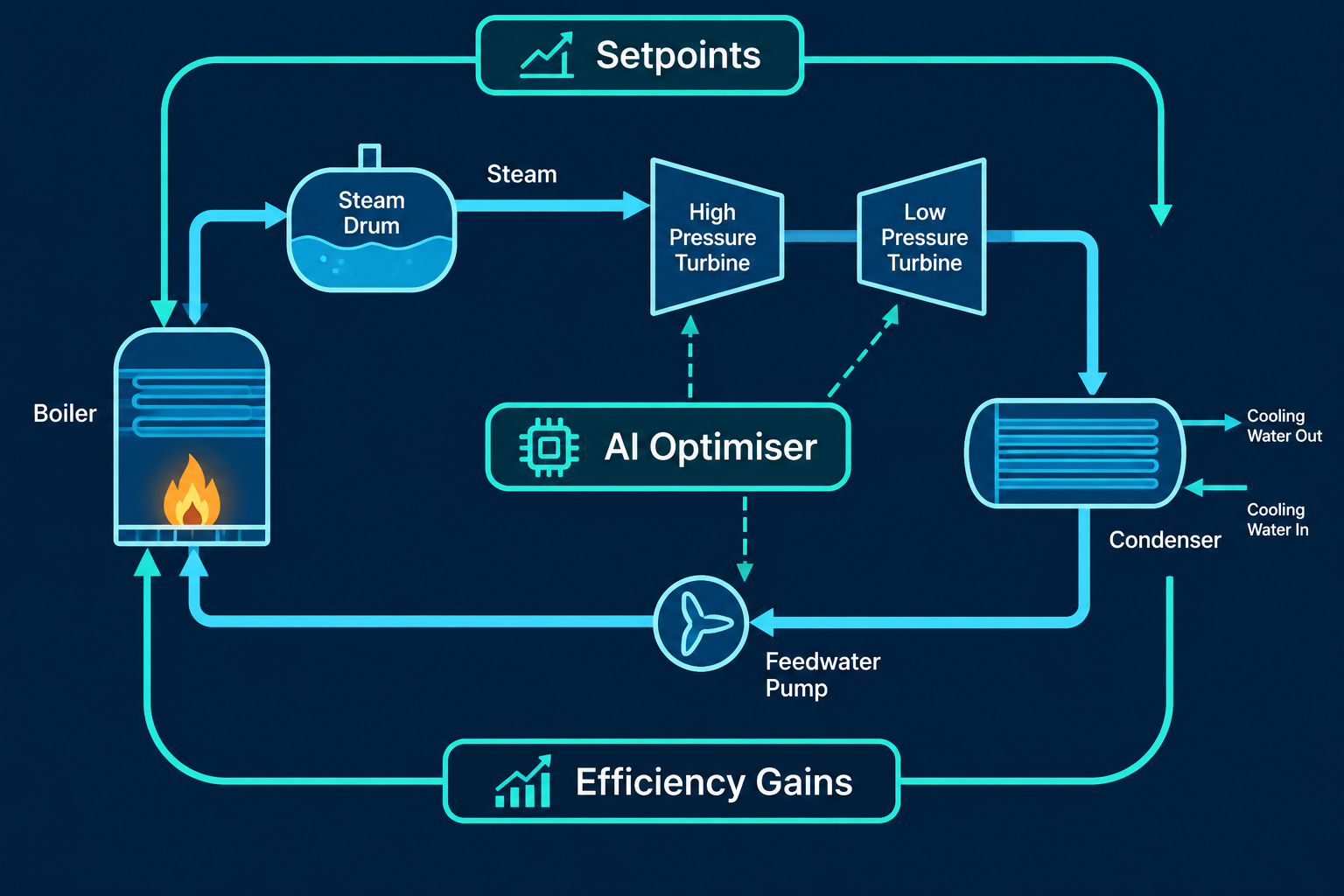
The steam cycle of a thermal power station is governed by dozens of interacting control variables: firing rate, combustion air, feedwater flow and temperature, reheat spray, condenser backpressure, extraction flows and more. Every one of those variables has an efficiency consequence, and the interactions between them are complex enough that no operator team can hold the entire system at its optimum by hand. Conventional plants run close to, but rarely exactly at, the best achievable operating point, and the accumulated gap is worth real money: utilities that have deployed AI-based steam cycle optimisation commonly report efficiency improvements in the range of one to two percent, with some units recovering substantially more when starting from a degraded baseline. Because the technology works by adjusting existing control setpoints rather than installing new hardware, it offers one of the highest returns available in thermal generation today, arriving as software on top of the distributed control system the plant already owns.
The Steam Cycle as an Optimisation Problem
In principle, plant engineers have always understood that efficiency depends on setpoints. Excess combustion air must be low enough to limit stack loss yet high enough to complete combustion and limit slagging. Final feedwater temperature affects both cycle efficiency and boiler behaviour. Condenser vacuum improves with cooling water flow, but circulating pumps consume power that partly cancels the gain. Each tradeoff has a calculable optimum, and traditional performance engineering solved these optima one at a time using heat balance calculations refreshed after major equipment changes.
The limitation is combinatorial. In a real unit, the optimum for one variable moves whenever load, fuel quality, ambient conditions or equipment condition change. A solution calculated for full load on a summer afternoon is wrong for a fifty percent load ramp on a cold night. Manual optimisation also assumes operators have spare attention to apply it, an assumption that cycling duty has quietly destroyed. AI-based steam cycle optimisation treats the problem differently: it builds a validated model of how efficiency and key constraints respond to every manipulated variable, then solves for the best combination continuously, as conditions change. The mathematics is demanding, but the concept is simply the plant performance engineer’s tradeoff analysis, executed every few minutes instead of once a year.
Suppliers have embedded the capability in their standard automation portfolios, which has accelerated adoption. Major control system vendors now ship plant optimisers alongside their distributed control products, configured per unit and supported through the same lifecycle agreements as the control system itself. That packaging matters for utilities managing dozens of units, because optimisation arrives with the organisation’s existing support arrangements rather than as a separate technology to be procured, secured and staffed. Independent software firms remain active where utilities want vendor-neutral tools or specialised models, but the direction is consistent: what began as a specialist retrofit is now part of the standard specification for thermal unit modernisation.
Advisory and Closed-Loop Optimisation Architectures
Most programmes begin with an advisory deployment. The optimiser receives live plant data, computes recommended setpoints and displays them to operators alongside predicted savings, while the existing control system remains untouched. Operators judge the recommendations against their own understanding of plant condition, and the advisory period doubles as model validation: recommendations are accepted or declined, outcomes are logged, and trust is built on evidence. Plants typically run advisory mode for several months before granting the optimiser any authority over actual control.
Closed-loop deployment follows only after that confidence is established. In the standard architecture, the optimiser writes setpoint adjustments to the regulatory control layer of the distributed control system, which retains all its protective limits and interlocks. The optimiser nudges targets, such as the excess oxygen setpoint or the reheat spray demand, within an explicitly defined envelope, and hard safety constraints sit below it at every level. Scope is expanded gradually, one loop at a time, with the ability to revert to manual operation at any moment. This incremental approach reflects a sound engineering judgement: optimisation must earn its place in the control hierarchy, and a utility that skips the validation discipline inherits a system nobody trusts when conditions turn unusual.
The choice between advisory and closed-loop operation also carries an organisational dimension. Advisory mode keeps operators fully responsible for execution, which preserves their authority but caps the achievable gain, because the optimiser only helps when staff act on its recommendations. Closed-loop control captures the benefit continuously but demands rigorous change management: operators must understand what the system is doing, retain clear override authority and receive training on the rare conditions that call for manual takeover. Plants that document override criteria and rehearse them with shift teams report the smoothest transitions, while those that treat the optimiser as an opaque box accumulate quiet overrides that quietly disable the savings.
Setpoints Most Often Targeted by Optimisation Systems
Field experience across coal, gas and combined cycle units shows the same variables appearing again and again in optimisation programmes:
- Excess oxygen at the boiler, where small reductions cut stack loss directly but must be balanced against carbon monoxide formation, slagging and unburnt carbon in ash.
- Boiler exit gas temperature, influenced by sootblowing strategy and air preheater performance, since every degree of recoverable heat left in the flue gas is fuel purchased and wasted.
- Main and reheat steam temperature, held as close to design limits as equipment condition allows, because reheat temperature in particular has a strong effect on cycle efficiency.
- Condenser backpressure and circulating water pump operation, solved jointly to maximise net output rather than vacuum in isolation.
- Feedwater heater performance and extraction steam allocation, where stuck valves and misassigned extraction flows silently degrade cycle efficiency.
- Auxiliary equipment dispatch, including fan and mill combinations in multi-train configurations, where alternative operating combinations can differ measurably in auxiliary power consumption.
The common thread is that each target involves a genuine tradeoff rather than a simple maximise-or-minimise instruction, which is precisely why model-based optimisation outperforms fixed operating instructions written for design conditions.
Operating Within Constraints: Equipment Limits and Cycling
Optimisation for efficiency can never be separated from the physical condition of the plant. Setpoint adjustments that raise efficiency may also raise metal temperatures, increase thermal stress or shift slagging behaviour, so the optimiser’s objective function must include constraints that protect equipment life. Modern implementations carry explicit penalty terms for approach to limits, tube metal temperature margins and ramp stress, and they enforce plant-specific restrictions that engineering teams define during commissioning. The correct product of optimisation is not maximum theoretical efficiency but maximum sustainable output per unit of fuel over the life of the asset.
Flexible operation sharpens this requirement. When a unit ramps with solar and wind output, the efficient setpoints for steady load are no longer correct, and the transitions themselves are where much of the avoidable loss sits. Optimisation also has to work hand in hand with flexible operation, because the setpoints that are efficient at steady load must be re-evaluated continuously during ramps, which is where AI-enabled boiler load management complements the cycle optimiser to keep the unit stable and efficient through the transition. Fleets that treat the two technologies as an integrated pair, rather than as separate projects, report smoother ramping behaviour alongside the efficiency gains, because the optimiser accounts for the dynamic cost of aggressive setpoint moves.
Implementation Pathways and Measurable Results
Utilities typically roll out optimisation in three stages: model development and validation on a single unit, advisory operation with measured results, then closed-loop control extended across the fleet with lessons transferred between stations. The measurement discipline matters as much as the software. Because efficiency gains are claimed against a moving baseline, credible programmes establish a validated pre-deployment baseline, account for load and fuel variations, and verify savings through side-by-side comparison with non-optimised periods. Independent verification of this kind protects the programme when budget reviews arrive.
The fuel and carbon context shapes the arithmetic further. In markets with administered fuel supply and regulated tariffs, the savings case rests on fuel cost reduction alone, which is still compelling where fuel is imported or supply constrained. In carbon-priced systems, each efficiency point carries an additional avoided carbon cost that can add materially to the business case. Utilities evaluating the investment should model both effects across the expected operating profile, since units expected to spend many hours at part load recover different gains from those running baseload, and the value of optimisation scales with the diversity of conditions the unit actually faces.
The economics explain sustained adoption. A one to two percent efficiency gain requires no fuel price assumption to justify, consumes no additional water, generates no permitting questions and pays back within a couple of years at prevailing fuel costs in most markets. For ageing fleets facing pressure to demonstrate responsible operation of thermal assets through the energy transition, AI-based steam cycle optimisation has become one of the few investments that improves cost, emissions and grid-support capability simultaneously, which is why it now features in the standard modernisation packages of major plant automation suppliers rather than in the exotic pilot category where it began.