
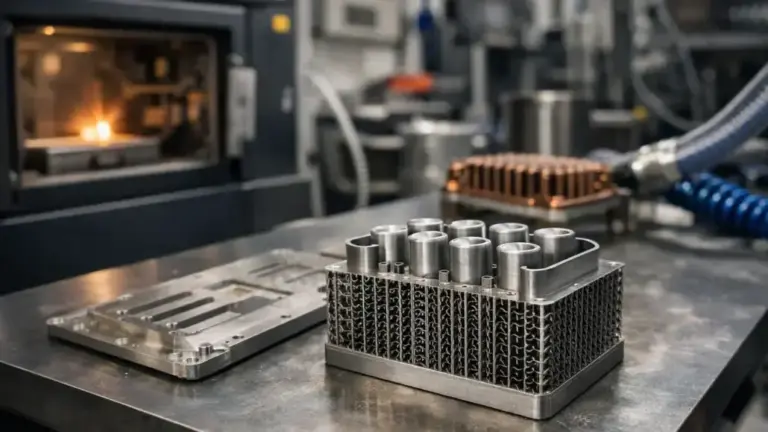
Johns Hopkins Applied Physics Laboratory – APL engineers in Laurel, Maryland, are working on a new thermal-management capability so as to help control heat in systems where weight and space are restricted.
SPEAR – Smart Phase-change Enhanced Re-entry uses phase-change materials – PCMs and additive manufacturing for building high-capacity heatsinks. It is well to be noted that PCMs are capable of absorbing and storing heat when they transition from one physical state to a new one. This means they can hold higher temperatures without raising the temperature as rapidly as traditional materials do. It is intended for systems that produce heat from electronics but have limited means to eliminate it, and they still need to comply with stringent size, weight, and power – SWaP limitations.
According to one of the mechanical engineers at APL, Yoni Ferneau, “PCM heatsinks can be useful anywhere you have electronics that generate a lot of heat over a short period of time. That could include hypersonics, space systems, radio-frequency electronics, transmitters, interceptors, and other transient or low-duty-cycle systems.”
It is worth noting that a phase-change heatsink stores heat by melting a material, just as ice melting in a drink helps keep it cool, said Greg Merboth, who is a senior mechanical engineer at APL.
When the material is melted, it is capable of absorbing and storing heat more effectively compared to a traditional metallic heatsink. This allows you to reduce size and weight by over 50% while maintaining thermal capacity.
Built and Assessed In-House
Historically, phase-change heatsinks have been built from complex structures of machined parts, however recent advances when it comes to additive manufacturing presented the team with a new way to tackle this and building high-capacity heatsinks were a way of doing it.
Merboth adds, “Because of advances in additive manufacturing, we thought it would be feasible to fabricate our own single-piece phase-change heatsinks.”
Prototype heatsinks and a test unit have been developed by the SPEAR team so as to test the concept. The team started with an aluminum heatsink baseline and built two SPEAR heatsinks for parallel testing. One SPEAR heat sink was identical in volume to the aluminum version, demonstrating the thermal storage capacity of a phase-change design in the same area. The other was designed to correspond to the thermal capacity of a conventional aluminum heatsink, demonstrating how much size and weight can be minimized while holding the same volume of heat.
Apparently, the PCM heatsinks were stuffed, sealed, and tested with no leaks. The team evaluated the SPEAR heatsinks against the conventional metallic design and demonstrated the predicted performance and SWaP benefits.
To help with the comparison, the team designed an integrated test unit that adds heat to a number of heatsinks at once and logs and shows the resultant real-time temperature variations to show how each design performs in similar circumstances. The testing also points out the importance of APL’s design, fabrication, and evaluation team – The SPEAR heatsinks were designed and 3D-printed, and the hardware, software as well as packaging for the demonstration unit were created in-house as well, enabling the team to swiftly test, assess, and optimize the concept.
As per Danielle Hilliard, who manages design, engineering, and fabrication at APL, “SPEAR demonstrates how our engineers can take a common technical challenge and develop a capability that can be tailored for different mission needs.”