
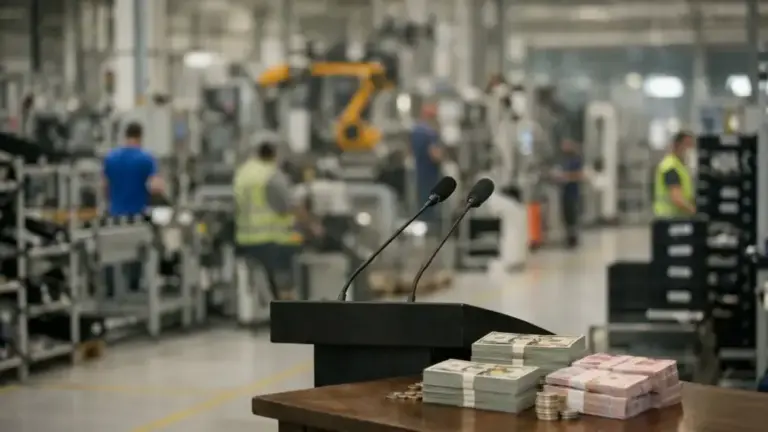
A launch of TL 250 billion, or $5.18b finance package for manufacturing sector of Turkey, Mehmet Fatih Kacır, the Industry and Technology Minister, stated on August 28, 2026.
The package will offer loans to SMEs as well as large companies for a duration of a maximum of 36 months, with a grace time of a maximum of six months, Kacır said at an event in Istanbul.
Financing is designed to ease access for manufacturers to funding and to incentivize businesses to retain job levels.
The announcement follows President Recep Tayyip Erdoğan’s statement late July 2026 that the government would raise the Investment Commitment Advance Loan Program to TL 750 billion from TL 500 billion.
The move is an element of a wider TL 1 trillion funding package to assist Turkish manufacturers and exporters, as well as industrial investment projects as economic conditions tighten.
Under the revised support mechanism, companies will be provided with conventional loans with fixed and floating financing costs, Kacır announced.
The maximum loan sum for large companies has been raised from 50 million TL to 150 million TL, whereas individual company limitations will be calculated proportionally to labor costs.
Funding cost as low as 25%
Loans with fixed rates under the program will have a financing rate of 37%, while for loans with variable rates, the rate of interest will be the Turkish Lira Overnight Reference Rate – TLREF plus 1 percentage point, Kacır said.
Those that keep their mean employment level from January to June during the July to December period will qualify for 12 percentage points of the cost of funding to be paid by the government.
This could bring down the yearly financing cost of fixed-rate loans to as low as 25%, Kacır said.
The program will also offer credit assurance support to SMEs.
Starting September 01, 2026, companies will be permitted to submit applications pertaining to this 5.18b finance package for manufacturing sector of Turkey. Kacir added that they are in a period of redefinition of global balances, a period during which geopolitical conflicts accelerate the quest for economic and technological dominance.
According to Kacır, Türkiye is progressively cementing its status as a center for production and investment in a period when protectionist barriers are increasing, supply chains continue to be reshaped, and geopolitical conflicts are challenging the global economy, standing out with its steadfastness.
Kacır adds that, thanks to the attempts of industrialists and government initiatives, the index of industrial production has risen 3.5 times in the last 23 years. They are a leading manufacturer in Europe in various industries, including solar panels, home appliances, and commercial vehicles, as well as iron and steel.
Kacır says the objective now is to double the extent of proposed industrial zones in Türkiye from 160,000 hectares to 350,000 hectares by the end of the decade and boost manufacturing exports to $400 billion.
The minister said that Türkiye is the country that can export the most extensive range of goods to the maximum number of countries in a wide area, from China to Central Europe, and that too in a competitive manner and that their production-focused economic model has enabled them to increase their national income from $238 billion to $1.6 trillion.