
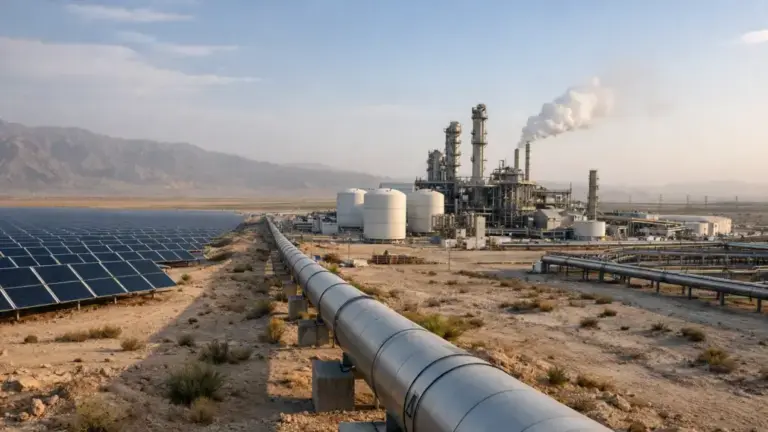
In Kuqa, which is a city located in northwest China’s Xinjiang Uygur Autonomous Region, solar panels stretch in rows throughout the vast Gobi Desert. The green electricity that they go on to generate travels over 20 kilometers to a hydrogen production plant, where it gets used to electrolyze water into hydrogen. The hydrogen is then piped off to a refining and chemical company for usage.
The plant is the Sinopec Xinjiang Kuqa Green Hydrogen Pilot Project, which is regarded as the first green hydrogen refining project in China that has an annual capacity of 10,000 tonnes. The project started producing hydrogen on 30 June 2023, integrating hydrogen production, storage, and transportation along with application. It generates green hydrogen straight from photovoltaic power through using the abundant solar energy of the region and supplies it to Tahe Refining & Chemical Company, which is a subsidiary of the largest oil refiner in China, Sinopec. When it comes to the oil refining process, green hydrogen goes on to replace the natural gas that was used before.
Li Ruixia, who is the manager of the hydrogen energy management department at Sinopec Star New Energy Co., Ltd., said, “If the project runs at full capacity, it can cut carbon dioxide emissions by about 485,000 tonnes a year.” She adds that the project has functioned pretty safely and in a stable way for over three years, proving feasibility when it comes to green hydrogen’s large-scale industrial applications.
It is well to be noted that hydrogen is a non-conventional secondary source of energy with wide-ranging uses. Hydrogen production is the first link of the industrial chain of hydrogen. Hydrogen can be produced in one of three ways, producing three distinct kinds of hydrogen having different levels of carbon emissions. Grey hydrogen gets produced out of fossil fuels such as natural gas or coal and has pretty high carbon emissions. Blue hydrogen is produced via fossil fuels but with more complicated and expensive technologies so as to reduce carbon emissions.
Green hydrogen, on the other hand, is produced through using renewable electricity from wind and solar in order to electrolyze water.
It is worth noting that hydrogen is also an important feedstock when it comes to industrial oil refineries. Moving from traditional grey and blue hydrogen to green hydrogen offers new growth prospects for the hydrogen sector and also helps the low-carbon transition in the petrochemical sector.
The fact is that the potential of green hydrogen isn’t limited to refining but can be made use of in industries including steelmaking, power generation as well as transport. Apparently, the China Iron & Steel Research Institute Group Co., Ltd. successfully completed the entire process in terms of producing high-purity iron by way of using pure hydrogen metallurgy technology at its pure hydrogen shaft furnace demonstration line located at the Linyi Lingang Economic Development Zone in Linyi, Shandong province, in east China. The line has gone on to achieve regular production of direct reduced iron with a metallization rate of over 96% and batch trial production of 3N-grade – 99.9% high-purity iron.
The main byproducts of iron oxide reduction with hydrogen are metallic iron as well as water vapor, so the tail gas from the pure hydrogen shaft furnace does not emit any kind of harmful substances and greatly reduces the impact on the environment. It is the first demonstration project in China to successfully apply pure hydrogen shaft furnace technology. It has run stably for over 8,000 hours, with one continuous run of more than 2,000 hours, thereby completely demonstrating its reliability and security.
Interestingly, hydrogen’s high energy density makes it especially suited for long-distance transportation. Hydrogen is now widely utilized across public transit and cold-chain logistics as well as trunk-line freight.
Notably, in order to transport visitors to the Beijing 2022 Winter Olympic Games, SPIC Hydrogen Energy, which is a subsidiary of State Power Investment Corporation, provided 200 hydrogen-powered buses with fuel cell systems. The buses operated in adverse conditions, which included low temperatures, snowfall, and mountainous roads, travelling a total of more than 880,000 kilometres, which decreased carbon dioxide emissions by more than 620 tonnes, with zero carbon emissions at the time of operation, with zero accidents as well as zero operational errors throughout the course of the event.
By the end of 2025, overall sales of hydrogen fuel cell vehicles in China totalled almost 40,000 units. Applications for hydrogen fuel cell technology have moved beyond passenger vehicles and now include mining trucks, ships, and drones, as well as rail transit. In the meantime, the country had built out 574 hydrogen refueling stations, with a total daily refueling capacity of over 360 tonnes. When it comes to the industrial sector, green hydrogen had begun to gradually substitute conventional fuels in part of the refining and coal chemical processes, while the annual green hydrogen production capacity of the country had reached around 250,000 tonnes.
All these changes go on to reflect a broader shift that points out to the fact that the hydrogen sector in China is moving from technology demonstration to large-scale commercial usage, and the potential for application is growing.
The hydrogen sector in China is experiencing significant growth, fuelled by increasing market demand, coupled with enterprise innovation throughout the industrial chain, and backed by aggressive government policies. Hydrogen has been included as a strategic priority when it comes to several national plans. The outline of the 15th Five-Year Plan – 2026-2030 identifies hydrogen as an essential sector for future industries. The strategy for building a new energy system in the same period incorporates hydrogen in the non-fossil energy supply system and sets a goal to produce 2 million tonnes of hydrogen from renewable sources of energy.