
Technological advancements are vital to a country’s capacity to innovate and compete. Next-generation infrastructure, manufacturing, energy systems, electronics, and even medicine need new materials with features that current materials cannot provide.
However, the process of identifying and verifying those materials can be tedious, costly, and manual, forcing researchers to prepare samples, conduct experiments on specialized equipment, and repeat the cycle by means of trial and error.
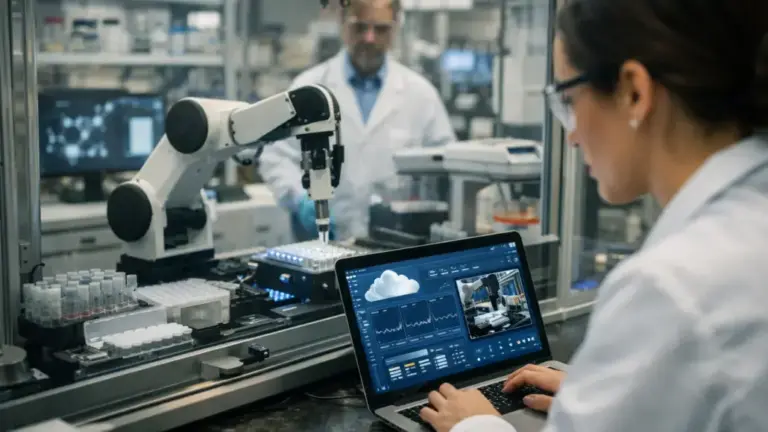
Now, Georgia Tech looks forward to making a fundamental change in materials and manufacturing research by establishing a new Programmable Cloud Laboratory that employs artificial intelligence, simulation, and autonomous experimentation in order to speed up that process substantially.
Developed on the premises of Georgia Tech’s Advanced Manufacturing Pilot Facility – AMPF which is a core facility of the Georgia Tech Manufacturing Institute – GTMI, the cloud lab will enable researchers all over the country to direct their work remotely, optimise experiments based upon results and AI suggestions, and delve into advanced manufacturing capacities without spending weeks on-site. In operation, the Programmable Cloud Laboratory will deliver the facility to the researcher.
According to the executive vice president for Research, Tim Lieuwen, “By making advanced manufacturing and AI-driven experimentation accessible from anywhere, we are accelerating the discovery of critical new materials and shaping the future of U.S. innovation. Georgia Tech is proud to provide the world-class infrastructure to help meet this national need and strengthen our research partnerships.”
It is worth noting that the cloud lab is funded by $18.1 million from the National Science Foundation – NSF and is part of a larger effort to establish a national network of 20 AI-enabled cloud labs. The labs are intended to work in tandem, ultimately enabling researchers to integrate capabilities and processes throughout the network. The new research ecosystem is going to bring together advanced scientific infrastructure with expert knowledge across the nation.
According to Aaron Stebner, Eugene C. Gwaltney, Jr., Chair, GTMI associate director, and professor in the School of Materials Science and Engineering and the George W. Woodruff School of Mechanical Engineering (ME), “Researchers can ask a question, have work recommended by AI agents, have experiments carried out at the facility using robotics, and get the results back. They can use AMPF resources to advance their own research without having to be experts in each piece of equipment or send students to AMPF for weeks at a time.”
The cloud lab will broaden AMPF’s capabilities to a much larger audience by cutting down the cost and challenges to doing that research, Stebner said.
A research lab that’s self-driven
Interestingly, AMPF is a mixed-use space where both industry and academic partners can identify new materials and accomplish manufacturing research. Today, the facility is making strides toward autonomous workflow capability on some 38 pieces of equipment. The cloud lab will bring automated and autonomous workflows to over 100 of AMPF’s 160 pieces of equipment, the team said.
It is worth noting that the cloud lab will also bring together the various stages of materials development which have traditionally occurred independently, enabling researchers to look into materials discovery, manufacturing, testing, as well as scale-up within the identical research environment.
The automation is beyond single pieces of equipment, said Pascal Van Hentenryck, director of the NSF AI Institute for Advances in Optimisation as well as A. Russell Chandler III Chair in the H. Milton Stewart School of Industrial and Systems Engineering. Robots can function as machines and shift materials from one station to another, physically executing workflows asked for by researchers from distance AI will help figure out which machines and robots are necessary for each task and control their movements throughout the facility.
Van Hentenryck happens to compare the process to following a recipe.
He says, “When you cook, you have a recipe, and the recipe tells you what you have to do. You don’t need to understand exactly how the stove is working. You just need to know what you need to accomplish with it.”
AI agents will acquire those high-level recipes from researchers, accelerate them into comprehensive workflows, and manage experiments, simulations, and information flows all over the facility.
Apparently, the system will depend in part on digital twins—virtual models of the facility that can assist in helping organize, track, and enhance experiments before and during their implementation. The system is also intended to learn from each run, enhancing how machines are optimized and how upcoming workflows are planned, Van Hentenryck said.
The project will include the Automatic FLOW for Materials Discovery software platform from Duke University, led by professor Stefano Curtarolo, to link computational discovery to physical testing and enable researchers to more quickly recognize and assess potential new materials. The data platform will seamlessly connect researchers, instruments, and data as well as IT systems throughout the distributed network and will be offered by Contextualise, founded and led by Branden Kappes. Georgia Tech AI will also make contributions to the project as part of the larger research team.
The cloud lab will help connect a long-standing gap between research and industrial adoptions. Companies are often hesitant to disrupt functioning production lines to try out unproven technologies, and startups and academic researchers frequently do not have access to industrial-scale labs where they can show their ideas work. AMPF offers an environment where new and emerging technologies can be evaluated and be risk-free without interfering with commercial production.
As per executive director of GTMI and Agustin A. Ramirez/HUSCO International Distinguished Chair in Fluid Power Systems in ME, “The cloud lab will give industry partners and manufacturers the ability to evaluate new ideas before they commit to large-scale deployment. This initiative will shorten development cycles and make it easier to bring promising technologies into production, enabling our partners and us to innovate at the speed of thought.”
Increasing Access to Advanced Research
The project will benefit over 400 users from 150 academic, industry, and government institutions, over half of whom will participate remotely.
Van Hentenryck said that “making these autonomous labs available to a very wide community is key to innovation. You provide a lot of people the opportunity to try things out.”
The cloud lab expands on a larger initiative that Georgia Tech has undertaken by means of AMPF for years which is integrating AI, automation, as well as advanced manufacturing to establish a flexible research environment which can grow with technology, broaden access, and reinforce U.S. leadership when it comes to materials and manufacturing.
When it comes to Stebner, the cloud lab is an essential next phase in making that vision a reality.
Stebner adds that “We are six years into this effort, and we are already at a place that I thought it would take us 20 years to get to. This cloud lab is going to take us to a level of technology, research, leadership, and access that I didn’t know if we would reach by the end of my career.”