
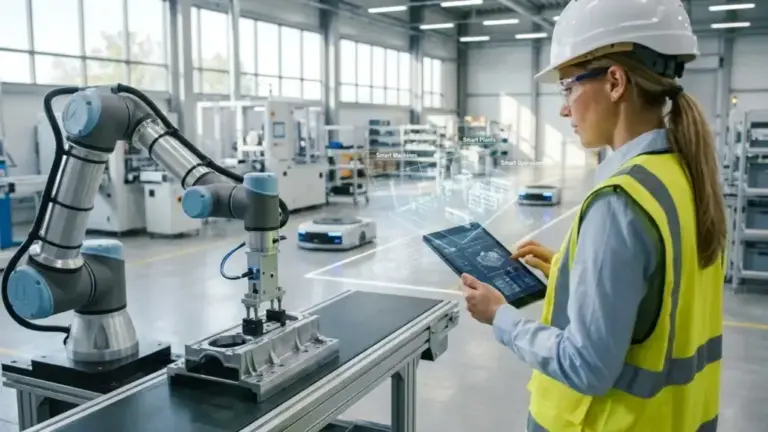
AI-native engineering company Altimetrik has launched an industrial AI service line with three solutions in order to help manufacturers as well as other enterprises embed AI directly into the machines, factory floors and supply chain operations.
The three solutions are Smart Machines, Smart Plants and Smart Operations. These are able to operate standalone or as an integrated system. They enable semiconductor, defence, automotive, aerospace, industrial machinery OEM, pharmaceutical and various other organisations to begin with a single machine or use case and scale to entire plant and company-wide autonomous operations.
According to the CEO of Altimetrik, Raj Sundaresan, the measure of industrial AI is simple: how much waste does it remove from the line? Less downtime, less scrap, less capital tied up in inventory. This service line takes the engineering discipline of ALTi AIOS™ to the factory floor, and our work with LMW shows what that looks like: AI embedded in the machines themselves, improving accuracy and uptime.
Apparently, the industrial AI service line is business-outcomes-led and offered by means of three integrated motions – executive advisory, pilot to platform, and strategic transformation. The Smart Machines, Smart Plants and Smart Operations solutions target OEMs wanting to incorporate AI into their primary products, manufacturers seeking to optimize production across machines and lines and also service providers wanting to improve performance and reliability for the assets they manage.
It begins with Smart Machines, which turns equipment into self-aware and adaptive systems via edge-native intelligence. Smart Machines employs machine connectivity, digital twins, closed-loop optimization and predictive maintenance to find and fix problems before they impact production, cutting downtime and enhancing machine performance.
Smart Plants brings those abilities to the factory workspace as a copilot. Smart Plants offer control over production lines by way of plantwide data integration, OEE and throughput intelligence, and high-quality prediction systems, enabling perception-decision-action. The outcome is no-touch operations that enhance output and reduce cycle times, labour, and quality costs.
Smart Operations, on the other hand, applies AI across the broader manufacturing value chain. Smart Operations uses service and supply chain metrics to improve operational performance, minimize working capital needs and open up new sources of revenue.
R. “Ray” Wang, the Founder, Chairman and Principal Analyst, Constellation Research Inc., says that “Customers seek AI services firms who tie machine intelligence to plant-wide and enterprise-wide outcomes. This is the type of pragmatic approach manufacturers need to get past pilots and deliver real results, rather than treating AI as a standalone capability.”
Industrial AI is more than reporting, analytics, and automation tools. It sees, makes choices, and performs actions in the physical world by processing machine telemetry and sensor data in actual time to make edge decisions in milliseconds. Lakshmi Machine Works – LMW Limited, which is one of the leading engineering conglomerates in India and also a global player in the textile machinery and machine tools sector, just partnered with Altimetrik to integrate AI and ML capabilities throughout its textile and machine tools business.
The Chairman and Managing Director of LMW Limited, Sanjay Jayavarthanavelu, said, “In our ongoing engagement with Altimetrik, we remain fully assured of their proven AI-powered automation capabilities to drive tangible value across our global operations through improved machine accuracy and uptime. This, we believe, will reduce shop-floor skill dependency, thereby accelerating our service responsiveness. We look forward to deepening this partnership as we continue to embed such intelligence across our product portfolio.”
The industrial AI solutions by Altimetrik work with the current physical and operational technology infrastructure that manufacturers have in place, so they do not need to substitute hardware, sensors or edge devices. Each task is operated under the human-at-the-helm philosophy of the company, where the operator retains control and oversight as AI takes on greater duty in the production setting.