
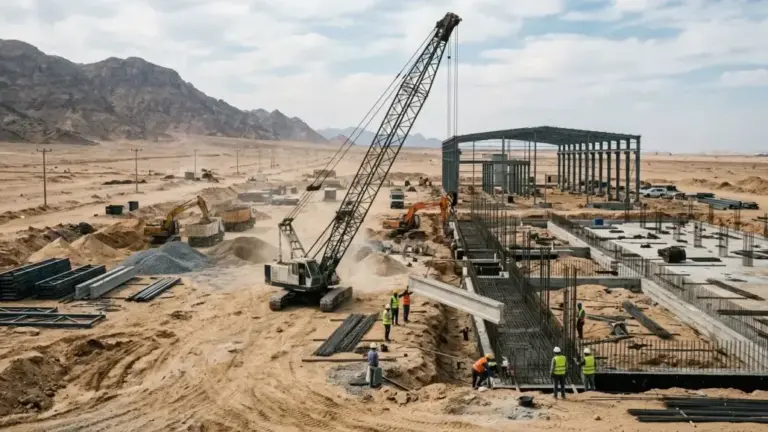
Elsewedy Electric, which is Egypt’s electricity giant, is investing $200m in 3 new manufacturing projects in Egypt. This is to further enhance the position of the country in the regional supply chains and to boost its export potential.
The projects, which will be operational in the first quarter of 2028, go on to include copper recycling and manufacturing of copper tubes, as well as manufacturing of aluminium rods. The two are expected to create over 300 direct jobs and roughly 1,000 indirect job opportunities.
Why Should You Be Bothered About These Developments?
It is well to be noted that in recent years Egypt has looked to establish itself as a manufacturing and export center for markets in Africa, the Middle East and Europe. The latest investment from Elsewedy Electric is an indication of ongoing trust in that approach.
The projects are not only creating new industrial capacity but also targeting industries of increasing global importance such as critical industrial materials, recycling, and export-orientated manufacturing. They additionally endorse Egypt’s attempts to boost local value creation by making use of raw materials locally instead of relying on imports.
According to President and CEO of Elsewedy Electric, Eng. Ahmed Elsewedy, “Through these investments, we aim to enhance value creation within the Egyptian market, develop more efficient and sustainable supply chains, deepen local manufacturing, reduce reliance on imports and support exports, while reinforcing Egypt’s position as a manufacturing and export hub serving regional and global markets.”
Among the new projects is the construction of a modern complex for the recycling of copper scrap along with electronic waste. It also has a copper tube manufacturing unit for the air conditioning and refrigeration – AC & HVAC and home appliance markets.
In addition, it involves a new aluminium rod production line which is exclusively for export markets. Together, these projects are anticipated to generate more than 300 direct jobs and 1,000 indirect job options.
The Details
The largest aspect of the growth is the e-waste & copper recycling complex. It is a high-level recycling complex for copper scrap and electronic waste, with an investment of about USD 80 million. In the first phase, the plant will treat up to 20,000 tonnes of copper scrap and printed circuit boards a year. In addition, it seeks to create over 120 direct employment opportunities.
The complex will use advanced processing technologies to transform copper scrap and e-waste into high-purity copper cathodes as well as precious metals. Further, the complex will be built with a standard engineering layout that allows for potential expansion and higher capacity for production.
The project also encourages a circular-based economy strategy by supplying locally recycled copper cathodes to the planned copper tube manufacturing facility from Elsewedy Electric. This integration contributes to streamlining the supply chain while producing greater value for industrial materials in Egypt.
The company also plans to spend US$65 million on a new plant to make copper tubes. When operational, the plant will be able to produce 15,000 tonnes per year and will result in over 100 direct jobs in its first phase. The plant will serve the increasing needs of manufacturers of air conditioners, HVAC, and refrigeration as well as home appliances. At the beginning, the production will be centred upon meeting the domestic demand and decreasing its reliance on imported components, in addition to supporting local manufacturers.
A third project involves building a new aluminium rod line for USD 55 million. The plant will add around 50,000 tonnes of yearly production capacity, leveraging the manufacturing experience of Elsewedy in Egypt and Saudi Arabia. The aluminium rod plant is being built for export markets only, unlike the copper tube manufacturing facility. The project is projected to create over 100 direct jobs and help Egypt increase its industrial exports.
The Ripple Effect
This kind of growth by Elsewedy Electric reflects a wider trend of increased value-added industrial manufacturing in Egypt. With the country looking to boost exports and enhance domestic production capacity, capital investments in recycling, advanced materials and export-orientated manufacturing are emerging as key pillars of industrial development.
The recycling aspect is particularly noteworthy. With the world electrifying and investing in renewable energy and grid expansion, the demand for copper is increasing. Having access to recycled copper has grown increasingly strategic. Companies that can reclaim and recycle these materials domestically may have a competitive advantage and mitigate their exposure to unstable commodity markets.
The projects could additionally offer opportunities for logistics providers, suppliers, and industrial contractors as well as export-orientated businesses that support the manufacturing ecosystem of Egypt.
What To Expect in the Times to Come?
The next milestone will be the deployment of the three facilities ahead of their projected opening in 2028. In collaboration, they will bring fresh capabilities in the fields of recycling and copper processing as well as aluminium manufacturing, increasingly vital to international industrial supply chains.
The investment of $200m in 3 new manufacturing projects in Egypt serves as an example for Egypt of how investment in industry can be converted into higher-value exports, more resilient domestic output, and better integration when it comes to regional and global markets.