
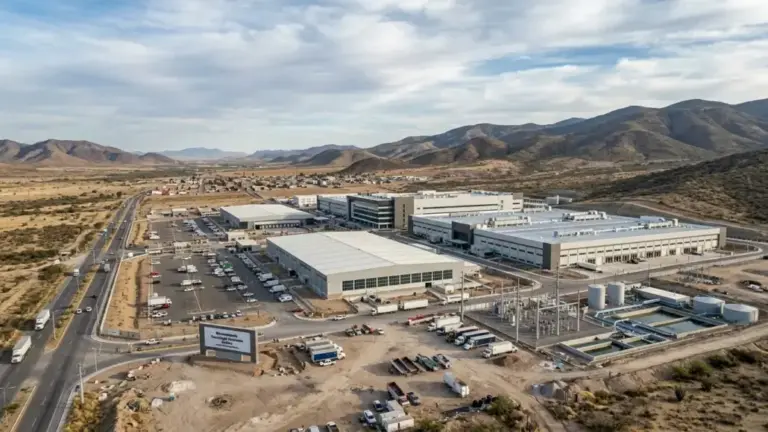
As an AI infrastructure boom unfolds, Taiwanese technology companies are rushing to ramp up AI manufacturing across Mexico in order to secure North American supply chains. While export numbers point to structural growth, arising electricity and water constraints throughout the regions of industry hubs present bigger operational obstacles for capacity scaling in the long term.
According to AccessBridge, at least eight Taiwanese tech companies have started setting up operations over the past two years to boost AI manufacturing across Mexico along with advancing electronics and automotive components. This is a strategic answer to a structural reshaping of international trade, where nearshoring enables manufacturers to sidestep geopolitical obstacles and to tap the North American market.
AccessBridge International’s managing partner, Edgar Braham-Herrera says, “Mexico clearly is a fundamental partner for them because it allows them to scale production that they perhaps previously did in Asia, or in China, or in other Asian countries, but now due to market conditions and geopolitics, they need a partner that allows them to keep scaling.”
The rate of acceleration in Taiwanese investment corresponds with a transformation in the export profile of Mexico. In 2025, national exports were US$664.8 billion, as per an analysis by the director of economic and financial analysis with Banco Base, Gabriela Siller.
Notably, it is for the first time that computer equipment in tariff category 8471 was the leading export engine, ahead of the automotive industry. The segment earned US$ 85.4 billion with a share of 12.85% of total exports. The growth rate of 144.81% in annual terms happens to be higher than the total export growth of 7.64%.
According to Siller, the biggest driver is increasing technology infrastructure spending in the US. Apparently, the United States invested US$102.2 billion in data centers in 2025, an almost 30% year-over-year increase driven by cloud computing as well as the generative AI boom.
Average tariffs on Mexican electronics within the U.S. are 0.45%, compared to more than 10% for Chinese commodities. Production continues to be concentrated in 5 states, namely, Chihuahua, Jalisco, Baja California, and Tamaulipas as well as Nuevo Leon, with Texas accounting for over two-thirds of shipments.
Siller takes into account a disconnect between trade output as well as capital introduction, as foreign direct investment within the computing subsector was limited to US$631 million in 2025, accounting for 0.46% of national foreign direct investment. Sector employment rose a bit by 3.84% to just over 331,000 workers.
Short-term expansion is constrained as plants are operating at close to full capacity with utilization at 99.5%. The dependency is still high, as a review of Banco Base shows that a 1% increase in the gross domestic product of the United States generates a 7.54 percentage point rise in exports of computer equipment from Mexico.
Scalability Threatened by Regional Infrastructure Pressures
The huge influx of manufacturing operations as well as computing facilities has revealed severe constraints in regional resources, creating operational friction throughout major industrial corridors.
Since 2020, corporations like Google, Microsoft, and Amazon have invested over US$12 billion in Queretaro, which has led to 12 data centers in operation. This is in line with a federal plan endorsed by Claudia Sheinbaum, the Mexican president. In September 2025, CloudHQ announced a US$4.8 billion investment to build 6 facilities by 2027, creating an estimated 900 permanent jobs.
But hyperscale cooling systems are a burden on regional infrastructure. Local groups, such as the National Antorchista Movement, are demanding the state government be transparent, since the state government excludes facilities situated in industrial parks from normal ecological impact reports. People living nearby Viborillas are being rationed water on a strict schedule, so they only get it three days a week.
There was a water shortage before data centers, says secretary of sustainable development for Querétaro, Marco Del Prete.
Adriana Rivera, the Mexican Data Centre Association’s director, adds that these facilities are employing high-efficiency cooling so as to reduce consumption. But Context’s research shows water allocation metrics are frequently hidden behind non-disclosure agreements.
The same bottleneck is the electrical infrastructure. MEXDC estimates national capacity to get to 1.5GW by 2030, accounting for 5% of planned national energy expansion. One needs the power of a whole city to build a hyperscale facility, says the founder of AllAI Consulting, Masheika Allgood. CloudHQ, apparently, is investing US$250 million in proprietary infrastructure.
Socioeconomic commitments are facing parallel delays. Microsoft said its US$1.3 billion investment would create 300,000 jobs; however, 2025 data shows just 64 people working at one location. A review by Context in late 2025 found 19 out of 21 community projects pledged by UN-Habitat as well as Microsoft in 2022 were still unfinished.
Jalisco Faces Unprecedented Power Demands
Jalisco is dealing with parallel capacity pressures. Flex, an electronic manufacturing company with 40,000 employees in 8 domestic plants, said it will expand by US$1 billion in 2026 on top of US$2.3 billion it has put away recently.
In a press conference with President Sheinbaum on April 16, 2026, the Director of Business Development and Government Relations, Flex, Guillermo del Río, said the capital would cover the cost of components for data centers and AI servers.
The energy required for the manufacturing process is unprecedented. The plant will consume equivalent of seven times the electricity consumption of the Port of Manzanillo, which processed 3.89 million TEUs in 2025, or 220 MW, explains Del Río. In particular, server testing alone takes up more than 115,000W.
The need for such assurances arises amid the need for and unfilled plans by Foxconn so as to build an AI superchip factory in Guadalajara.
Pablo Lemus, the Jalisco Governor, and Emilia Esther Calleja, the Director of the Federal Electricity Commission, pledged to ensure industrial electrical supply on May 25, 2026, whereas initiatives such as a new laboratory inaugurated by Aguascalientes Governor Tere Jiménez aim to secure a human capital pipeline.