
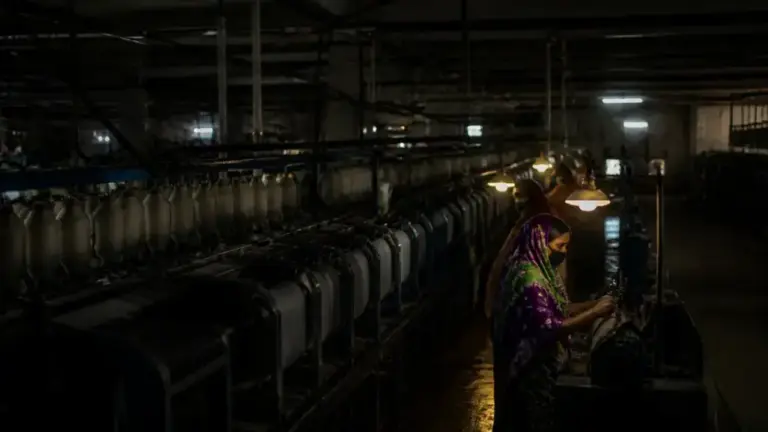
Persistent electricity and gas shortages are putting Bangladesh’s manufacturing sector under increasing pressure, disrupting factory operations and weakening production, employment and investment prospects. Industrial units are facing prolonged interruptions, with power outages averaging 4.1 hours daily in April-June 2026, almost twice the average recorded in 2025. Gas supply interruptions added another 3.2 hours of disruption per day.
Energy availability emerged as the biggest operational concern, with 79% of surveyed factories identifying power and fuel shortages as their primary business challenge. Industrial output among medium and large manufacturers contracted by 0.4% during the April-June quarter compared with the average quarterly production in 2025.
The findings are part of the first phase of the BIDS-BCI Industry 100 Index, a joint initiative by the Bangladesh Institute of Development Studies (BIDS) and the Bangladesh Chamber of Industries (BCI). The assessment covered 130 factories, examining production trends, operating expenses, workforce conditions and business confidence.
Textile Sector Faces Steep Production Decline
The Bangladesh energy crisis has had a particularly severe impact on textile manufacturers. Capacity utilisation in the sector fell from 73% in 2025 to 55% during April-June 2026, accompanied by a 20% reduction in production.
The ready-made garment (RMG) segment, however, recorded a contrasting performance, with output increasing by 2% over the same period. Across all surveyed industries, average factory capacity utilisation edged down from 67% to 66%.
Unreliable electricity supplies have also affected manufacturers’ operating conditions. Only 7% of factories expressed satisfaction with electricity availability during April-June 2026, compared with 38% in 2025.
Higher Input and Operating Costs Add to Pressure
Manufacturers are simultaneously dealing with escalating expenses. Approximately 94% of surveyed businesses reported higher raw material costs, while average fuel expenditure per factory increased by 5%. Transportation expenses also climbed 10%, adding further pressure on operating margins.
Employment indicators reflected the slowdown in industrial activity. The combined workforce across surveyed factories declined from 137,100 in 2025 to 135,700 in April-June 2026, representing a reduction of around 1%.
Both new hiring and employee turnover per factory dropped by 19%, suggesting that manufacturers are prioritising workforce stability rather than expanding recruitment amid uncertain business conditions.
Industrial Business Confidence Remains Below Neutral
Sentiment among industrial businesses continued to weaken, with all five indicators measuring factory performance over the preceding three months recording scores between 36 and 43. Each remained below the neutral benchmark of 50.
Expectations for July-September 2026 were more encouraging, however, with the production growth expectation index reaching 54. This indicates cautious optimism about a possible improvement in manufacturing activity if supply constraints become less severe.
The Industry 100 Index has been developed to provide consistent updates on manufacturing conditions, covering production, input availability and prices, employment and business sentiment.
Under the initiative, a permanent panel of 100 manufacturing units across 14 medium and large industrial subsectors will be monitored. These segments collectively account for approximately 90% of the output generated by medium and large industries.
A second-phase survey is currently underway to assess quarterly changes and provide further insight into the challenges facing Bangladesh’s industrial sector.