
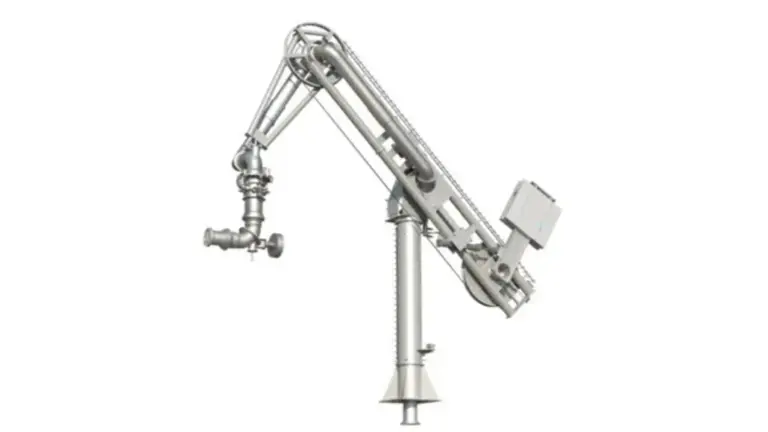
Kawasaki Heavy Industries Ltd.’s Yasuhiko Hashimoto, Representative Director, President and Chief Executive Officer, and TB Global Technologies Ltd.’s Masaki Takahashi, who is the President, a group company of Tokyo Boeki Holdings Corporation with its president Hideshige Tsubouchi, have jointly developed the first 6-inch liquefied hydrogen loading arm in the world for ship-to-shore liquefied hydrogen transfer.
The equipment is centred on the pilot-specification loading arm, first developed in 2018. In 2022, the pilot unit successfully carried out the world’s first operation of handling liquefied hydrogen cargo at the Hy-Touch Kobe liquefied hydrogen receiving terminal.
Kawasaki and TBG have designed and developed a commercial specification model and manufactured and inspected a prototype since August 2023. From August 2025 to July 2026, the companies conducted verification tests of liquefied hydrogen at the JAXA Noshiro Rocket Testing Center, verifying the technological basis necessary for the commercialization of liquefied hydrogen cargo handling equipment. Development is now completely finished for ship-to-shore liquefied hydrogen transfer.
The equipment was designed and tested to ISO 24132, the international norm when it comes to marine transfer arms for liquefied hydrogen, and has been ISO certified as commercial specification equipment.
Major Features of Commercial-Specification Equipment
1) Loading arm – New arm design with increased reach allows the loading arm to fit larger vessels.
2) Swivel joint – SJ – Increased equipment reliability thanks to the improved seal structure and the adoption of a new seal gas system.
– Reduced helium gas consumption while maintaining internal joint pressure for optimal sealing performance.
3) Emergency Release System – ERS – The drip pan that captures liquid oxygen produced during an emergency release utilises a gravity drop mechanism rather than a hydraulic actuation, which simplifies the structure.
– The emergency release is more reliable and maintainable due to a streamlined clamp mechanism.
4) Ship-to-shore coupler – SSC – Flangetype connection without insertion minimises operator workload, enhances operability and allows for a thinner and more compact design.
The SSC is designed to meet ClassNK technical certification needs, making it more practical and applicable for commercialization.
The equipment will be used in the demonstration project for commercialization of a liquefied hydrogen supply chain under NEDO’s Green Innovation Fund Project, Development of Large-scale Hydrogen Supply Chain.
Kawasaki LH2 Terminal under construction by Japan Suiso Energy, Ltd. – JSE in Ogishima, Kawasaki-ku, Kawasaki City, Kanagawa Prefecture, will install three units for usage in liquefied hydrogen shipment handling with a 40,000 m3-class liquefied hydrogen carrier.
Kawasaki and TBG will continue efforts to have the commercial-specification liquefied hydrogen loading arm implemented for projects in Japan and overseas going forward. The companies will improve the feasibility of cargo handling equipment necessary for large-scale marine transport of liquefied hydrogen and will speed up technology development and business development for the establishment of global liquefied hydrogen supply chains, thus contributing to the realization of a carbon-neutral world.