
A research team from The Hong Kong University of Science and Technology – HKUST in partnership with Arizona State University – ASU and The Hong Kong Polytechnic University – PolyU established a unified sustainable seawater-to-hydrogen system that can generate hydrogen directly from seawater and convert waste heat generated from electrolysis into a resource that can generate the purified water needed for hydrogen generation.
It is well to be noted that the technology integrates hydrogen production and water production, as well as thermal management into one system and has the potential to reduce dependence on freshwater resources when it comes to green hydrogen production and offer a new pathway for sustainable hydrogen development across the water-scarce regions.
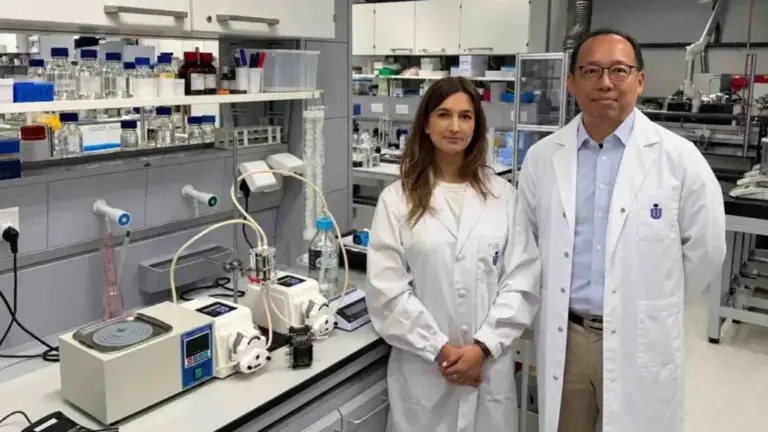
The research was led by Prof. SHANG Chii, a professor in the Department of Civil and Environmental Engineering at HKUST, along with Dr. Gabriela Scheibel CASSOL, who is the postdoctoral fellow in the same department and an HKUST PhD graduate in Environmental Engineering. Prof. Paul WESTERHOFF from Arizona State University and corresponding author Dr. SONG Yinghao, who is a postdoctoral fellow at PolyU and a PhD graduate in civil engineering from HKUST, were also part of the research team.
The research was published in Nature Communications under the title “Thermally symbiotic integration of osmotic membrane distillation and electrolysis for direct seawater hydrogen production.”
Innovative Design of Thermal Symbiosis for Resource Efficiency Enhancement
Renewable hydrogen could be important in the transition to a low-carbon energy system. However, traditional water electrolysis requires high-purity water, which is an additional challenge for the limited fresh water resources. Seawater is an abundant source for electrolysis, but the salts and other constituents can facilitate undesirable reactions and hasten membrane and catalyst degradation, thus making direct seawater electrolysis less feasible.
To face these challenges, the research team combined osmotic membrane distillation (OMD) and alkaline water electrolysis – AWE. The OMD process separates purified water from seawater and prevents the major seawater constituents from reaching the electrolyzer. This allows the system to benefit from mature alkaline electrolysis technology without direct contact of essential components with seawater contaminants.
The system’s innovation is at its heart, thermal symbiosis design. In the course of electrolysis some electrical energy must be converted into heat. Instead of just dispersing this heat with typical cooling, the scientists are harnessing it to power OMD for water creation. The OMD process simultaneously offers the possibility of heat dissipation from the electrolyzer, such that water production and thermal management are mutually enhancing, cyclically, for better use of the overall resources.
99% Rejection of Major Components in Seawater
The unified sustainable seawater-to-hydrogen system achieved more than 99% rejection of major seawater constituents using real seawater and retained stability for more than 500 hours of continuous operation, with Faradaic efficiency, in addition to hydrogen and oxygen purity, all in excess of 99%. The researchers also developed a thermal-water-hydrogen model that shows thermal circulation can be maintained within the efficiency range of commercially available alkaline electrolyzers, supporting the possibility of long-term continuous operation.
Prof. SHANG Chii, co-author of the study, said that “Developing hydrogen energy requires not only renewable electricity but also a sustainable water supply. Our research demonstrates a new approach that uses heat generated by the electrolysis process itself to produce the purified water needed by the system, transforming what would otherwise be waste heat into a valuable resource. This thermal symbiosis design not only improves the utilization of both energy and water resources but also demonstrates the feasibility of integrating seawater hydrogen production, desalination, and thermal management within a single platform. We hope this research can provide valuable insights for the future development of green hydrogen technologies in coastal and water-stressed regions.”
The team believes the innovation shows the potential to integrate seawater purification, hydrogen production, and thermal management on one platform. Future work will be focused on extending the application range of the system and further evaluating its performance under practical operating conditions so as to evaluate its potential for large-scale hydrogen production. According to the results reported, the technology is still in the laboratory validation stage, and further scale-up and long-term durability studies will be required before it can be deployed commercially.
This study was supported by the HKUST 30 for 30 Research Initiative Scheme and the PolyU Distinguished Postdoctoral Fellowship Scheme, along with the Theme-based Research Scheme of the Hong Kong Research Grants Council as Project No. T21-604/19-R.