
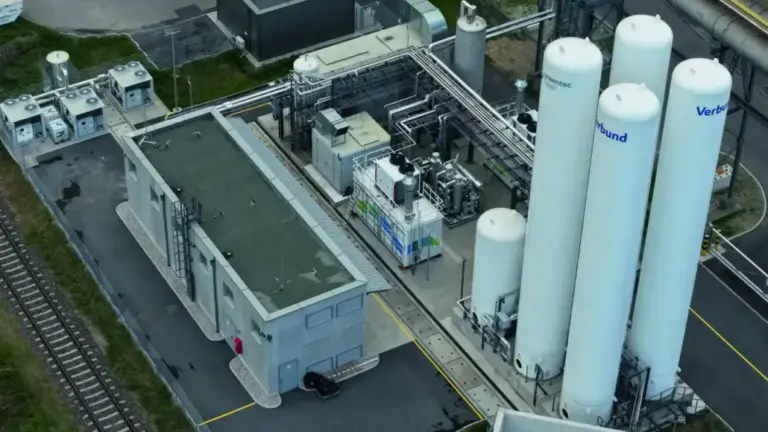
The globally renowned research project H2FUTURE hydrogen pilot at the voestalpine site in Linz is moving into its next expansion stage. In the last three years, the pilot plant has been modernised, so that the two project partners – the international steel and technology group voestalpine and Austria’s leading energy company VERBUND – can examine not only the production but also the compression, purification, storage, loading and further use of green hydrogen. This will be done by extending the plant at the voestalpine site, which has been in operation since 2019 as the world’s largest hydrogen pilot plant, to include a compression and purification unit and five hydrogen storage tanks. The cost of the expansion is EUR 16.4 million.
In addition to green hydrogen production, the H2FUTURE- The Follow-Up project is increasingly focusing on its treatment and provision for industrial applications, especially regarding quality characteristics such as purity and pressure. The hydrogen produced by electrolysis is compressed, purified and temporarily stored in the expanded H₂FUTURE plant. Four of the five new hydrogen storage tanks will serve to balance fluctuations in hydrogen production and consumption, helping to ensure security of supply. Beginning in late 2027, the fifth shipping tank will feed the HY4SMELT industrial-scale demonstration plant, the largest climate protection research project in Austria, directly with hydrogen via a pipeline some 1 kilometre in length at voestalpine’s Linz site.
According to Herbert Eibensteiner, CEO, voestalpine AG, “With greentec steel we have a clear strategy to transform our steel production. In the first half of 2027, one green electricity-powered electric arc furnace at each of the Linz and Donawitz sites will go into operation, enabling us to save up to 30% of our CO2 emissions by 2029 as a first step. In the long term, we aim to achieve net-zero CO2 emissions in steel production by 2050. Hydrogen will play an important role in this process. Together with our partner VERBUND, we will gain further crucial insights thanks to this research infrastructure, the only one of its kind in Europe.”
In addition, the hydrogen can be compressed to almost 500 bar by means of high-pressure compressors and loaded into trailers for road transport. In turn, this will also be available to external customers and other research and industrial projects, e.g., the SuSteel research project at the voestalpine site in Donawitz, which uses hydrogen supplied from a caravan from research partner K1-MET.
Says VERBUND AG CEO Michael Strugl, “With H2FUTURE, together with our long-standing partner voestalpine, we are implementing an important reference project for the development of a green hydrogen economy. On an industrial scale, the project shows how renewable electricity can be converted into green hydrogen and harnessed for specific industrial applications. Thus, H2FUTURE directly supports our role as a leading producer of renewable energy and as a partner for decarbonizing energy-intensive industries.”
The first functional tests of the H2FUTURE follow-up project are already running. The first research results should be available by the end of 2026. The project will conclude in December 2030 and is supported by the Austrian Federal Ministry of Economy, Energy and Tourism.
H2FUTURE – the longest operational hydrogen pilot facility in the world
H2FUTURE hydrogen pilot at the voestalpine site is one of the longest-running proton exchange membrane – PEM electrolysis plants in the world and has been operating since 2019. It has 12 stacks of 50 electrolysis cells and a connected load of six MW. The plant can produce 1,200 cubic meters of green hydrogen an hour. Since its commissioning, it has generated nearly 2,000 tonnes of green hydrogen and run a number of test programs. A “stress test” confirmed the load capacity of the plant in continuous operation and the ability to react quickly to large load changes. It is particularly used to smooth out frequency fluctuations in the power grid that arise from the inconsistent availability of renewable energy or fluctuating electricity demand.