
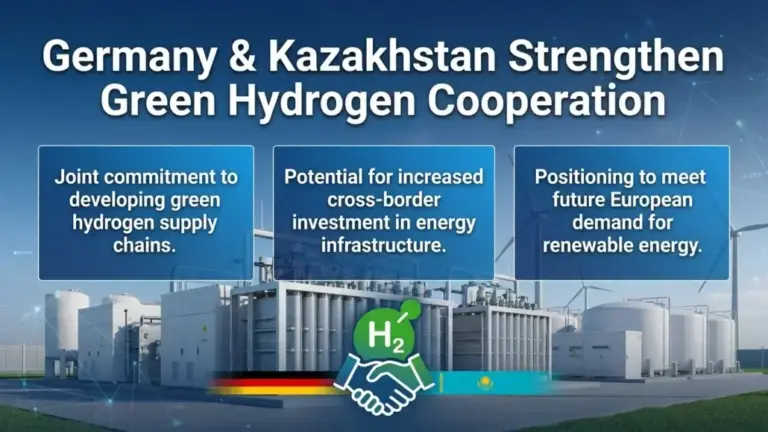
Between 29 and 30 September 2026, His Excellency Kassym-Jomart Tokayev, President of the Republic of Kazakhstan, paid an official visit to the Federal Republic of Germany at the invitation of His Excellency Frank-Walter Steinmeier, President of the Federal Republic of Germany. On this occasion the two presidents made the following joint declaration:
The two presidents welcomed the success of the cooperation between their countries since the independence of the Republic of Kazakhstan. They look positively to continued close cooperation in light of the experience gained in over three decades of successful cooperation, of the mutual trust, and of the increasingly deep political dialogue at the highest level.
They acknowledge the progress achieved so far and stress the importance of further reforms and further modernization of their respective countries to ensure a legally stable and economically advantageous environment, respecting the rule of law, the principles of democracy, the protection of human rights, investment security, an independent judiciary, and sustainable development.
The presidents reiterate their support for the Strategic Regional Partnership between Central Asia and Germany, launched in Berlin on 29 September 2023 in the context of the Central Asia and Germany Summit and continued in Astana on 17 September 2024 in the framework of the second Summit. They welcome the convening of the Meeting of the Ministers of Foreign Affairs of Central Asia and Germany in Berlin on 11 February 2026 and look forward to the upcoming third Central Asia and Germany Summit.
They welcome the growing comprehensive regional cooperation among the countries of Central Asia as an important step to further enhancing the autonomy, robustness, and prosperity of the region and cooperation on green hydrogen could be one way of doing it.
The presidents reaffirm their commitment to multilateralism and to the basic principles of international law and the Charter of the United Nations, including respect for the sovereignty, independence, and territorial integrity of all countries. They stress the need to resolve differences and disputes by peaceful, political, and diplomatic methods.
The presidents also emphasize the importance of achieving a comprehensive, just, and lasting peace in Ukraine in accordance with the principles of the Charter of the United Nations as soon as possible.
Trade, economic cooperation, and investments are the main pillars of cooperation, the presidents say. They reaffirm their mutual interest in increasing trade, diversifying the products traded, expanding investments, and localizing production.
The presidents welcome the measures taken so far to improve the parameters for German companies in Kazakhstan, in particular for small and medium-sized enterprises, and encourage the implementation of further reforms in this context. They underline their common interest in linking approaches to standards, considering German, European, and international standards.
The presidents acknowledge the crucial function of the Kazakh-German Economic Council, the Berlin Eurasian Club, the Kazakh-German Intergovernmental Working Group, the German Chamber of Commerce Abroad for Central Asia, and the German Eastern Business Association in developing economic relations and increasing mutual exports.
To further enhance industrial cooperation, the presidents welcome the joint roadmap for developing industrial, technological, and raw materials cooperation for 2026-2028. Special attention will be given to the development of joint production capacities, the extraction and processing of critical raw materials, the increase of the value-added of products produced in the country, and the establishment of reliable and resilient supply chains.
Both presidents welcome the close cooperation of their countries on improving energy security and diversification of supply sources and transport routes for energies, including supplies of oil and gas to Europe. In the fields of security of supply and energy corridors, they want to expand cooperation under the umbrella of the Kazakh-German Energy Dialogue and the H2-diplo office in Astana regarding the decarbonizing industry, expanding renewable energies, and cooperation on green hydrogen.
The presidents highlight the strategic importance of the Trans-Caspian International Transport Route for transport and trade networks between Asia and Europe. They welcome its further development as a sound and competitive route that helps to diversify transport links, deepen trade relations, and strengthen economic resilience. In this connection, they welcome the initiatives of Kazakhstan, Germany, and the European Union on the further development of transport infrastructure and improvement of networks.
Digital transformation, artificial intelligence, research, and space are promising spheres for the presidents’ cooperation.
The presidents note the possibility of further development of cooperation in the sphere of agriculture and food, based on the existing good partnership. They attach very great importance to the implementation of bilateral and regional co-operation projects and private-sector economic initiatives in this field.
They welcome the development of cooperation in the area of healthcare, especially in the area of medical science and its strengthening.
The presidents attach particular importance to cooperation in the areas of water, climate, the environment, and biodiversity, as well as to the sustainable management of natural resources, given the serious impact of climate change on the availability of water and the state of the ecosystems. They regard cooperation in these fields as an important component of bilateral relations and of the Strategic Regional Partnership between Central Asia and Germany and welcome the contribution of the Federal Government’s Green Central Asia initiative to this end.
Both presidents acknowledge the need for a regional approach to address transnational challenges in the climate and environmental space. They underline the importance of working toward the establishment of a regional environment and climate partnership between Central Asia and the Federal Republic of Germany, as provided for by the Berlin Declaration by the Ministers of Foreign Affairs of Central Asia and Germany of 11 February 2026, in an effort to strengthen cooperation in the areas of environment and climate.
The presidents welcomed the partnership between the Ministry of Water Resources and Irrigation of the Republic of Kazakhstan and the German trade association German Water Alliance. They put high value on joint projects in the water sector.
They support the development of cooperation in the areas of culture, youth, sport, science, and education between their countries.
In this context the presidents particularly welcome the intensification of direct contacts between scientific institutions and universities, the realization of joint research projects, the promotion of academic mobility and training of highly qualified specialists, as well as the further development of the Kazakh-German University in Almaty, including through a possible new campus, the establishment of a Kazakh-German school in Astana, and cooperation in the area of technical and vocational education and training. They stressed their common interest in promoting the German language in the schools and universities of Kazakhstan.
In this connection, they also endorse a proposal to create a Kazakh-German Future Forum as a forum for the exchange of young experts and professionals on the issues of the future, including green development, energy, digital transformation, and AI. They welcome the organization of the first forum in Saarland in the summer of 2027 and of a potential follow-up forum in Kazakhstan in 2028.
The two presidents support strengthening relations between the civil societies of the two countries and note the important role of the German minority in Kazakhstan in bringing the peoples of the two countries closer together and in fostering cultural exchange and people-to-people cooperation. In this connection, they praise the work of the Intergovernmental Commission on the Affairs of Ethnic Germans in the Republic of Kazakhstan.
The two presidents applaud the effective conclusion of negotiations on an agreement between the Republic of Kazakhstan and the European Union on the facilitation of the granting of visas as an important step toward further strengthening people-to-people ties and the implementation of the readmission agreement.
The presidents welcome the progress achieved on the foundations of the Strategic Regional Partnership – the economy and energy, transport and regional cooperation, resilience, climate and environment, and civil society contacts – and commit to further consolidating the Central Asia and Germany format as a platform when it comes to long-term and results-oriented collaboration.
The presidents express their mutual interest in building up bilateral cooperation by keeping up a political dialogue based on trust and by broadening relations, especially in trade and economy and in science, education, and culture.