
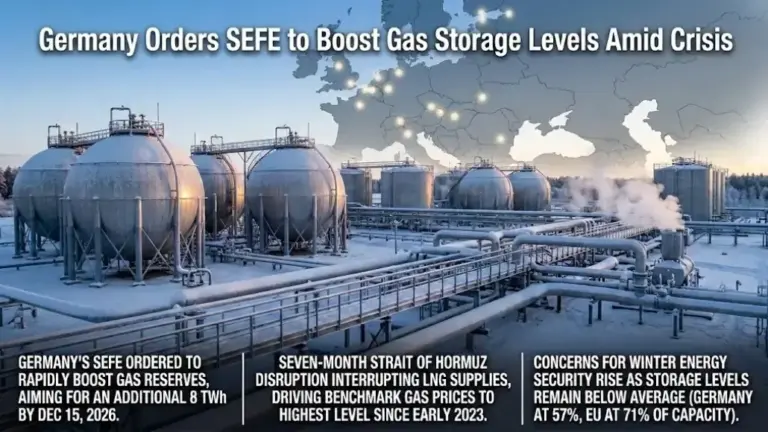
Securing Energy for Europe (SEFE), Germany’s state-owned natural gas importer, has been instructed to substantially enhance the quantity of natural gas held in storage facilities across the nation. The company announced this directive on 30th September 2026, with the goal of reaching an additional 8 terawatt-hours (TWh) of stored gas by 15th December 2026.
Background on SEFE and Germany’s Energy Strategy
Current Storage Situation Across Europe
Currently the country is navigating a fresh energy emergency driven by a seven-month disruption of liquefied natural gas (LNG) shipments via the Strait of Hormuz. Several key economies, including Germany, are currently maintaining natural gas stockpiles that fall below historical averages for this point in the accumulation period. Multiple factors have led to the rise of this energy crisis:
- With little financial incentive for energy firms to stockpile fuel, Germany is facing difficulties in replenishing its natural gas reserves.
- Meanwhile, benchmark gas prices have surged to their highest levels since the beginning of 2023.
The national directive to increase natural gas storage levels reflects growing concerns about European energy reserves heading into the colder months. As of September 29, gas storage facilities throughout the European Union maintained capacity levels of approximately 71 percent, notably below the 80 percent levels recorded during the same period last year and the five-year average.
The nation’s gas storage infrastructure, recognized as the world’s fourth-largest capacity, currently operates at just 57 percent of its potential, creating worries regarding supply sufficiency and energy security if winter temperatures significantly exceed seasonal norms.