
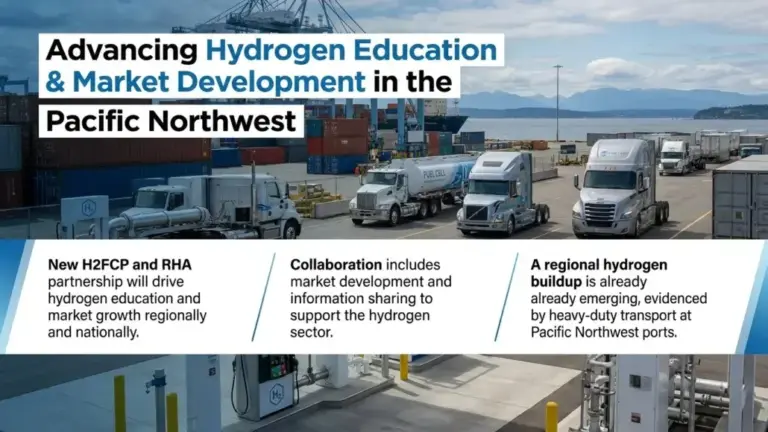
The Hydrogen Fuel Cell Partnership – H2FCP announced on September 29, 2026, a new Exchange Membership agreement with the Renewable Hydrogen Alliance – RHA, formalizing a collaboration to advancing hydrogen education across Pacific Northwest and also nationally in addition to market development, as well as information sharing.
A regional hydrogen buildup is already emerging on the ground. Currently, around 4,000 heavy-duty diesel trucks serve the Ports of Seattle and Tacoma, and the City of Seattle lists them among the area’s heaviest polluters. Washington has set aggressive decarbonization targets through a Clean Fuel Standard, zero-emission vehicle incentive programs, and state climate goals, providing both the regulatory foundation and the investment climate for hydrogen to scale. Oregon Energy Strategy has a sister program across state lines.
According to General Manager of Fuel Development at Toyota and H2FCP Board Member Justin Ward, “We’re enthusiastic about this advancement with the Renewable Hydrogen Alliance to build upon our mutual goal of cleaner mobility solutions across the West Coast and throughout the U.S. We’ve been developing and deploying hydrogen technologies in California for nearly three decades. We know what works, both in technology and the policies needed to succeed. We’re eager to build the hydrogen economy together.”
The region is also ahead on supply infrastructure. In the Pacific Northwest, hydropower accounts for about half of annual electricity generation, so renewable hydrogen producers are well-placed to tap abundant, low-carbon power for electrolysis. But the most recent assessment by the Northwest Power and Conservation Council estimates the region will need about 11 GW of new generation by 2032 so as to meet demand, making efficient use of current assets critical as hydrogen scales up. Washington lawmakers have already begun to support this buildout: in 2019, Governor Jay Inslee signed SB 5588, which allows public utility districts to produce and sell renewable hydrogen.
Opines Bill Elrick, Executive Director of H2FCP, “When we started expanding beyond California, we knew we needed partners who understood their regions as well as we understand ours. RHA has spent years building relationships with utilities, tribes, labor, and project developers across the Pacific Northwest. Formalizing this partnership means both RHA and H2FCP members benefit from that work.”
According to the agreement, H2FCP and RHA will exchange information on an ongoing basis between staff, engage with each other’s committees and working groups, exchange reports and educational resources, and collaborate on policy, market, and outreach opportunities as the renewable hydrogen sector evolves.
Says Erin Childs, Executive Director of RHA, “Renewable hydrogen only scales as fast as the relationships behind it. This partnership gives our members a direct line to H2FCP resources and best practices and provides H2FCP’s members access to a rapidly accelerating hydrogen market. This is a partnership that positions both California and the Pacific Northwest for the next phase of industry growth and scaling.”
This partnership to advancing hydrogen education across Pacific Northwest is timely as hydrogen infrastructure is spreading beyond the borders of California. In accordance with the Road Map to a US Hydrogen Economy, the US hydrogen economy could be worth $140 billion annually and generate 700,000 jobs by 2030, rising to 3.4 million jobs by 2050.
The same report predicts that hydrogen adoption could reduce U.S. transportation NOx emissions by 36 percent by 2050 since fuel cell vehicles have zero tailpipe emissions, advantages that are especially pronounced in freight corridors and communities that bear the heaviest pollution burden today.
As per Neil Hartman, Government Affairs for Washington State United Association of Plumbers and Pipefitters and Board Secretary of RHA, “With new hydrogen fueling stations continuing to come online in Washington State, we need to invest in the partnership and technical expertise that will enable our region to move forward with smart, informed hydrogen policy. The UA believes a renewable hydrogen economy is a clear win for our members, our community, and our energy infrastructure, and we’re grateful for this partnership to bring California’s hydrogen learnings and insights to the Pacific Northwest.”
Remarks, Operations & Technical Director at H2FCP and RHA Board Member, Jennifer Hamilton, “This collaboration aligns with a key H2FCP mission to share knowledge as a national non-profit, and with RHA’s efforts to develop the hydrogen market in the Pacific Northwest, working together to align key stakeholders for the expansion of the hydrogen transportation market.”