
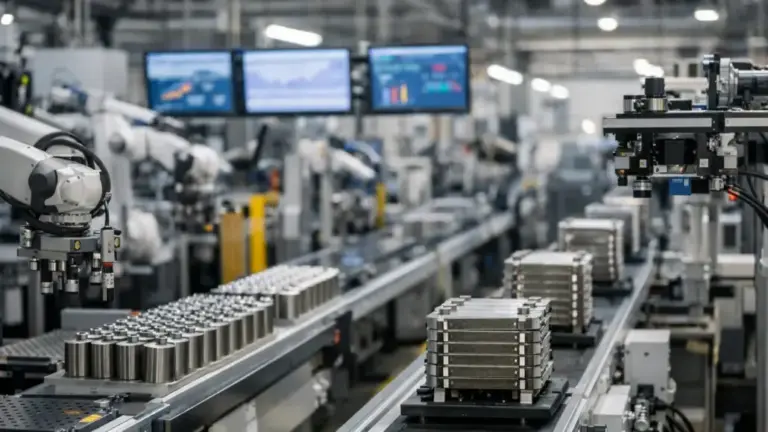
On September 23, 2026, Hysata, the Australian company that produces the world’s most efficient electrolyzers, announced HysataFab, its AI-optimized manufacturing platform, and installed the first production line based on the platform at the 8,500-square-meter Port Kembla headquarters.
HysataFab makes use of artificial intelligence in order to generate almost 15% more product from the same physical production line via the implementation of a bespoke system combining real-time tracking, robotics as well as inline quality testing.
The launch comes with a $49 million grant for Hysata by the Australian Government via the Australian Renewable Energy Agency – ARENA under the Future Made in Australia Innovation Fund. The grant was announced on site by Chris Bowen, the Climate Change and Energy Minister, along with Industry and Innovation and Science Minister Tim Ayres.
It is well to be noted that HysataFab is not a single plant but a platform of manufacturing facilities. Its first example is a project worth almost $100m at Port Kembla with three production lines for electrode and membrane as well as cell and stack manufacture, having an initial capacity of 50 MW per year on a single-shift basis. The electrode line now stands open, and the other ones will be too.
Hysata has raised over $220 million in total from investors around the world to date. The grant covers about 50% of the project cost, matched by Hysata from private capital. The ARENA grant is supporting the establishment and expansion of Hysata’s electrolyser manufacturing capacity. The line is operated by HysataFab, an AI platform developed and funded by Hysata.
The factory would be expanded to 200 MW per annum capacity with continuous operations, making it the biggest electrolyser manufacturing facility in the southern hemisphere. HysataFab is a repeatable template, so more units can be built as demand rises to meet gigawatt-scale capacity. The line is AI-optimized, so Hysata anticipates manufacturing output to be almost 15% higher than it would otherwise have been.
Paul Barrett, the Hysata Chief Executive Officer, said the real market for hydrogen was industrial feedstock and not the uneconomic applications such as passenger cars or home heating that attracted early attention.
The commotion around hydrogen has come out of the market and is considered healthy.
He added, “Hydrogen does not need to compete with electrification. You use it where you need a molecule, not an electron. In steel, in fertilizer, and in refining, there is no substitute for it. The world already uses more than a hundred million tonnes of hydrogen a year, nearly all of it made from fossil fuels. The challenge is not inventing a market. It is producing clean hydrogen at a price industry can afford, and cheaper renewables are opening new markets in green steel and fuels for aviation and shipping. Green hydrogen scales when the economics work, and efficiency is most of the economics. Hysata was built around a simple idea, which is to do more with less. Our electrolyser gets more hydrogen from every megawatt of electricity. HysataFab now gets more product from every manufacturing line. More hydrogen per megawatt. More product per line. Both compound as we grow, and both are pointed at the same thing, which is cheaper hydrogen.”
Chris Bowen, the Minister for Energy and Climate Change, said that “This project is a major job and economic opportunity for the Illawarra and helps ensure Australia makes more of the clean-energy technology the world needs. ” Hysata’s electrolyser can help reduce cost of hydrogen production and decarbonise energy-intensive sectors like steel, fertiliser, and heavy transport. Making electrolysers here in Australia is a huge opportunity to strengthen our manufacturing capability, back local innovation, create skilled jobs, and seize a bigger share of the global clean-energy technology market.”
Federal Member for Cunningham Alison Byrnes MP opines, “Hysata is a true local success story – born from University of Wollongong research, backed by the government, and now delivering to customers around the globe. The Illawarra has the skills, capability, and drive to help power Australia’s clean-energy future, and the Albanese Labor Government is backing local jobs, local innovation, and a Future Made in the Illawarra.”
It is worth noting that the Illawarra has the skills and capability as well as determination to help power Australia’s clean-energy future, and the Albanese Labour Government endorses local jobs, local innovation, and also a future made in the Illawarra.
Darren Miller, ARENA’s Chief Executive Officer, said the grant was about making an Australian invention an Australian industry. He added, “Turning breakthrough technology into commercial-scale manufacturing is one of the hardest steps in innovation, and it is where ARENA can make the most difference. Hysata’s efficiency changes the cost base of green hydrogen. This grant is about building the capability to manufacture it here, at scale.”
How the line gets to learn
HysataFab’s electrode line is the first electrolyser production line in the world to make use of AI to evaluate thousands of data points from every electrode it produces. Everything that’s made is a refinement for the next thing.
Notably, Hysata has spent three years building a digital record of how its technology performs across research, testing, and manufacturing. The record currently contains over 57 billion process data points. Each day, the business produces over 100 million new data points, far more than any engineering team can manually interpret.
Shaun Maris, Hysata’s principal AI engineer, says that they have been creating a digital record for every electrode with real-time sensing and inline inspection.
He adds, “Every electrode has a digital fingerprint. We capture thousands of data points as it moves down the line, and the AI reads that in real time. It picks up drift before it turns into a defect and closes the loop back into process control. Our AI agents analyze more process history each day than the entire team could in a career, running close to 10,000 analytical queries daily. This is how HysataFab learns: every component produced helps optimize the next, continuously improving quality and yield.”
According to Dr. Barrett, “There is plenty of noise around AI. What matters is whether it changes something you can measure, and at Hysata it does. Adding capacity is the easy part. Getting more out of the capacity you already have is the harder problem, and it is the one that lowers the cost.”
Efficiency in the machine and in the factory
Hysata’s capillary-fed electrolyser achieves 95% efficiency at 41.5 kWh per kilogram of hydrogen. That’s about 20% more hydrogen per megawatt as compared to current electrolyzer technologies and hence helps to reduce cost of hydrogen production.
Hysata’s system is also inherently low-cost to scale, with fewer parts and a lower capital cost per megawatt of manufacturing capacity. AI takes that edge from the machine into the factory.
From breakthrough to going commercial
In June 2026, Hysata won its first binding megawatt-scale export order, with a global heavy-industry leader, for delivery in the H1 of 2027. HysataFab will manufacture electrodes for that system.
Hysata has successfully trialed the technology in the field with ACWA Power in Saudi Arabia, has joint development agreements with POSCO as well as Vestas, and is collaborating with tier one customers throughout a multi-gigawatt pipeline in difficult-to-access sectors.
The International Energy Agency said electrolysis capacity installed globally doubled to over 4 GW in 2025, with another 2.5 GW under construction for 2026. Clean hydrogen has attracted committed investment of US$130 billion through over 570 projects, which apparently is an 18% increase in a year – with 90% of that capacity either under construction or already operating, the Hydrogen Council said.