
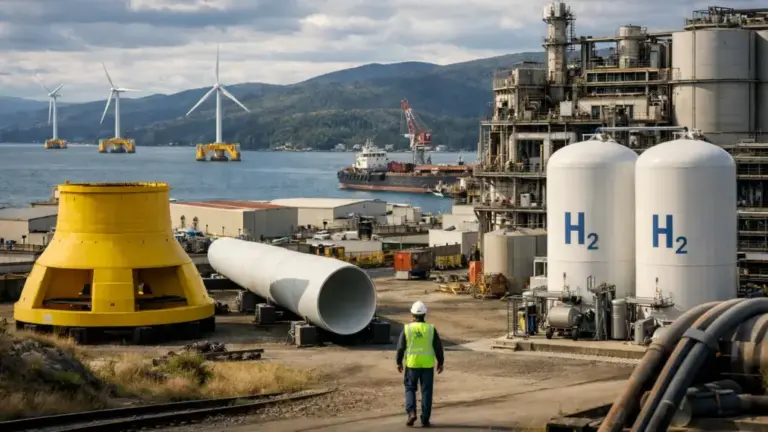
Hydrogen companies still see Tasmania’s Bell Bay industrial centre as a field of dreams, with the most recent idea being a $1.5bn 3D printing manufacturing hub.
PolarBlue, which is based in Perth, proposes to integrate its hydrogen energy technology and fibre glass-based 3D printing technology to produce floating wind turbines as well as low-emissions fuels, the company says.
An initial agreement with the state on job training and porting along with marine access has been signed.
It is well to be noted that Bell Bay industrial centre is a deep-water port and industrial centre located in northern Tasmania and has long been the centerpiece of the plans from the state when it comes to renewable hydrogen production as well as export.
PolarBlue is just the latest of many hydrogen probables to roll out a viral press release pertaining to the future plans for Bell Bay industrial centre. None of these plans has yet materialized.
It is worth noting that the Green Hydrogen Hub concept was awarded $330 million by state and federal governments, with the aim of being operational by 2028. However, proposals from the likes of Fortescue, Woodside, and Origin have so far proved unsuccessful.
The company is not looking for money from the state government, says the founder of PolarBlue, Grant Reynolds.
“We never asked Tasmania for a cent, only a fair process, and we got one. Bell Bay industrial centre is where we start advanced manufacturing at scale,” said Reynolds in a statement.
He added, “We are not asking anyone to accept that on faith. We are asking them to come and watch.”
More major commitments for Bell Bay
The fact is that the company is making some large promises with a pre-launch press release making some very large claims.
It is indeed promising to know that Bell Bay’s biggest arrival yet is going to give Tasmanians accessibility to the cheapest and cleanest power available on the planet.
This is going to be in addition to the 150 jobs as far as the first phase is concerned, nearly cancelling out the 250 jobs that were lost when the Liberty Bay smelter shut down in July 2026, and a $1.5 billion capital investment.
Interestingly, the press release, which announced the launch of the site, says it is going to spend that massive sum within 36 months. However, that will be subject to certain regulatory approvals pertaining to operating at 8 GW/month production capacity.
And there are the 3D-printed offshore wind turbines to supply electricity to the hydrogen equipment that produces low-emission fuels.
The AFR reports that modular wind turbines and platforms will be bolted together in order to form a harvester, which will sail to windy waters off Tasmania’s south so as to generate electricity or make use of seawater to produce ammonia, methanol, or hydrogen.
The plan is to place them in the open ocean, outside of any government jurisdiction. The company is said to have a working model that it is testing.
It is a 3-year investment to construct the manufacturing center, and it will be an asset for the entire state, says Felix Ellis, Tasmania’s Industry Minister.
He added in a statement that “PolarBlue’s vision to deliver globally significant outcomes using Australian technology is welcome in Tasmania. Tasmania is open for business, and we welcome PolarBlue’s commitment.”
The Steven Bradbury of hydrogen
Tasmania is still betting big on hydrogen at Bell Bay industrial centre being the industrial shot in the arm the north is looking for, with state officials openly referring to it as the Steven Bradbury of hydrogen. It is well to be noted that Bradbury was an Australian speed ice skater who went on to win a gold medal in the winter Olympics after all of his competitors went crashing out on the last curve.
Apparently, in 2025, hydrogen was generated at the port from PolarBlue and Abel Energy’s then-$1.7 billion Bell Bay Powerfuels project.
These interestingly are replacing the first wave of green hydrogen projects from very large companies.
Interestingly, PolarBlue has apparently lined up big investors from Japanese giant Sumitomo to the Wilson Transformer Company, but green hydrogen has beaten rivals with equally substantial funds in recent times.
Notably, Bell Bay was supposed to be the site of the first hydrogen plant from Fortescue, but the company could not strike a deal on a low power cost with the government.
Origin stopped its 500 MW project in 2023. Woodside, the oil and gas giant, was the latest company to pull the pin on operating, taking its planned H2Tas project out of the federal environment authorization process in August 2024.
Woodside said the decision had been guided by the dearth of availability when it comes to new renewable energy generation within the state so as to support commercial-scale electrolysis-based hydrogen generation.