Open RAN is entering a more commercially focused phase as operators move selected deployments beyond laboratory testing and limited field trials. The technology was initially promoted around open interfaces, virtualised network functions and the ability to separate hardware and software components. As those technologies mature, the central question is shifting from whether Open RAN can work to whether it can deliver the reliability, performance and operational consistency required in live commercial networks.
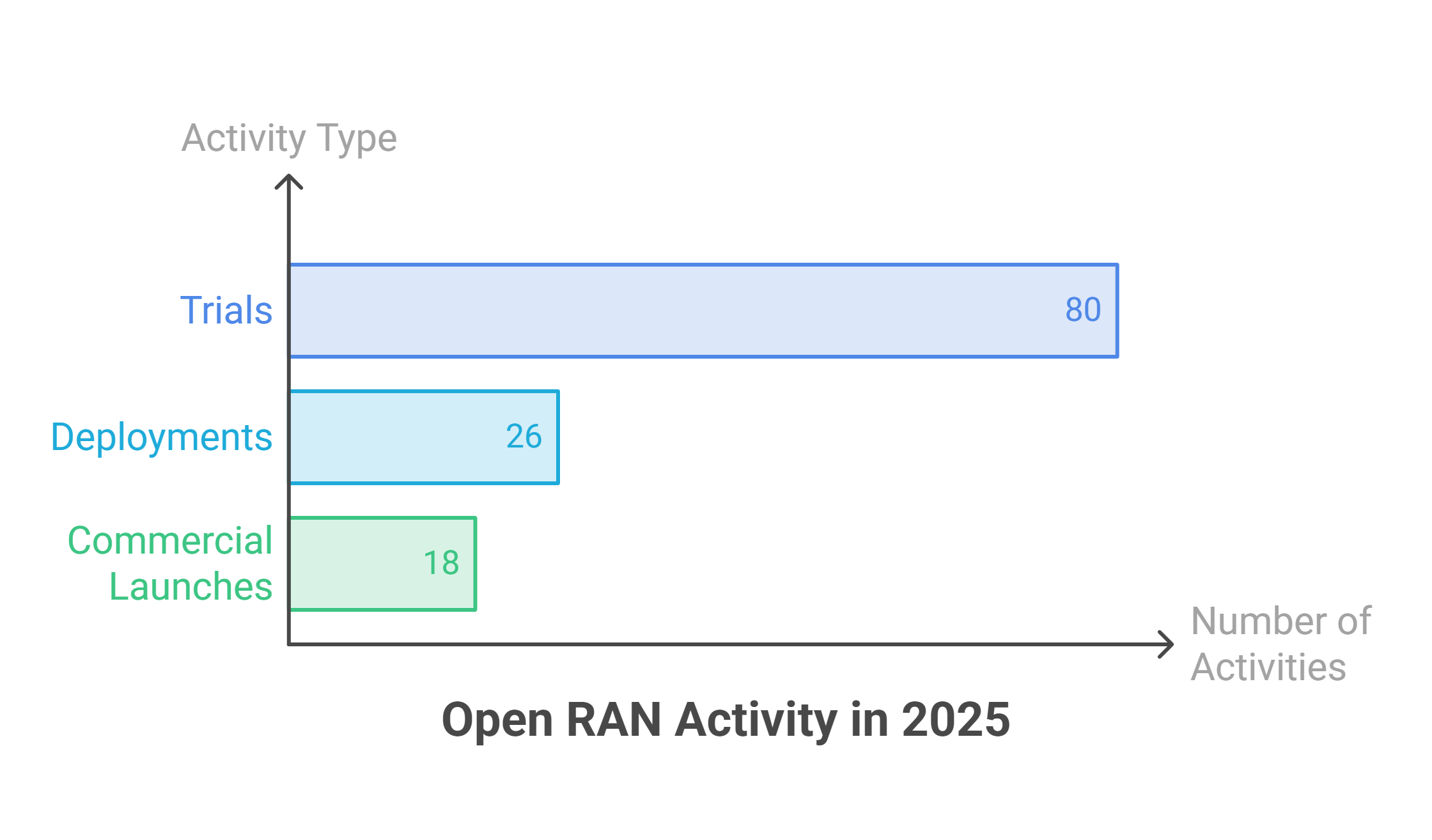
The latest deployment data shows that transition is underway, although it remains gradual. Industry tracking for 2025 recorded 18 commercial launches, 26 deployments and 80 trials across the markets covered. Trials therefore remained the largest category, accounting for roughly two-thirds of the combined activity, while commercial launches represented less than one-sixth. The figures indicate that open RAN adoption is moving toward commercial operation, but the market has not yet reached a point where commercial deployment dominates industry activity.
Commercial Deployment is Becoming a More Important Test
The distinction between a trial and a commercial deployment is significant. Trials can focus on interoperability, technical performance or specific use cases under controlled conditions. Commercial networks introduce additional requirements around availability, traffic management, maintenance, security and integration with existing network systems.
That is making brownfield deployment increasingly important. Early Open RAN activity was concentrated heavily around new or greenfield networks, where operators had greater freedom to design the architecture from the beginning. The next stage involves integrating open components into established networks while maintaining existing service levels. This places greater emphasis on interoperability and lifecycle management across multiple network components.
The O-RAN ALLIANCE is continuing to develop specifications aimed at supporting commercial 4G and 5G deployments. Its Release 5, completed in 2026, added capabilities covering AI/ML workflows, massive-MIMO optimisation, network energy savings and O-Cloud management. The organisation describes its specifications as being designed for implementation in commercial networks worldwide.
The continued development of these specifications reflects an important change in the open RAN adoption cycle. Industry efforts are increasingly focused on making open architectures easier to integrate, operate and scale rather than simply demonstrating individual technical components.
Performance Remains Critical to Scaling
Commercial progress, however, does not mean that the industry’s adoption challenges have disappeared. GSMA Intelligence’s 2025 Network Transformation Survey found that 22% of operators were in the initial phases of deploying open networking technologies including Open RAN, compared with 21% in 2019. The limited change over that period highlights how much slower adoption has been than some earlier expectations suggested. GSMA Intelligence also identified network performance as a significant factor limiting wider adoption.
This makes performance validation one of the defining requirements for the next phase. Operators need to establish that open components can maintain throughput, coverage, mobility performance and service reliability under real-world network conditions.
The industry’s testing infrastructure is evolving alongside these requirements. The Spring 2026 O-RAN Global PlugFest involved 13 operators, Open Testing and Integration Centres and other institutions across nine laboratories, with 31 companies and institutions participating. Testing covered multi-vendor end-to-end integration, massive-MIMO technologies, network efficiency and open-source software.