
Network slicing is moving into a more intelligent phase as 5G-Advanced adds new capabilities for managing increasingly demanding applications. Instead of treating a slice as a predefined configuration that remains largely unchanged, operators are working toward networks that can adapt resources to changing traffic, application requirements and service conditions.
At its core, AI network slicing allows multiple logical networks to operate over the same physical infrastructure, with each slice designed around particular performance requirements. GSMA identifies slicing as a core 5G capability for applications that need differentiated quality of service, including high bandwidth, low latency and predictable performance for areas such as industrial robotics and autonomous systems.
The arrival of 5G-Advanced strengthens the foundation for this model. 3GPP describes Release 18 as the first 5G-Advanced release, introducing further enhancements to the 5G system. Its work also includes enhancements around AI and machine learning for NG-RAN, including support for AI/ML-assisted network slicing and coverage and capacity optimisation.
This matters because future telecom infrastructure will have to support applications with very different requirements at the same time. A factory automation system may need highly predictable latency and reliability, while a large public event can suddenly generate a major increase in traffic. A single fixed network configuration cannot optimise equally for every situation.
AI can provide an additional intelligence layer by analysing network conditions and helping determine how resources should be allocated between slices.
From Virtual Networks to Intelligent Network Resources
Traditional network slicing already separates services according to defined requirements. The next step is making those slices more responsive.
An AI-enabled system can continuously examine information such as traffic levels, latency, network performance and service conditions. Instead of relying entirely on manual configuration, it can help determine when a slice needs additional capacity, when resources can be released and when network policies should change.
This is moving from predefined slicing toward adaptive slicing.
The development is already being demonstrated in live-network environments. In February 2026, an industry collaboration demonstrated an agentic AI-powered 5G-Advanced slicing solution in a live 5G network. The system monitored network KPIs including bitrate and latency, combined them with contextual information such as traffic, incidents, locations, events and weather, and automatically adjusted RAN policies to meet service requirements.
The demonstration covered the RAN, transport and core, showing why AI-driven slicing is becoming an infrastructure challenge rather than a feature confined to the radio network. It also used four operating modes: chatbot, on-demand, scheduled and autonomous.
That architecture points toward a broader change in telecom infrastructure. The network is not simply providing separate virtual paths for different services. It is beginning to acquire the intelligence needed to decide how those virtual resources should respond as conditions change.
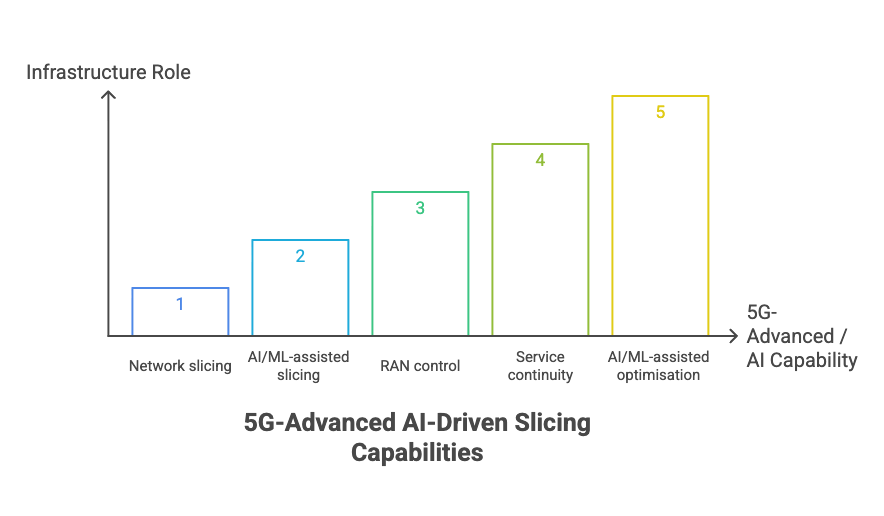
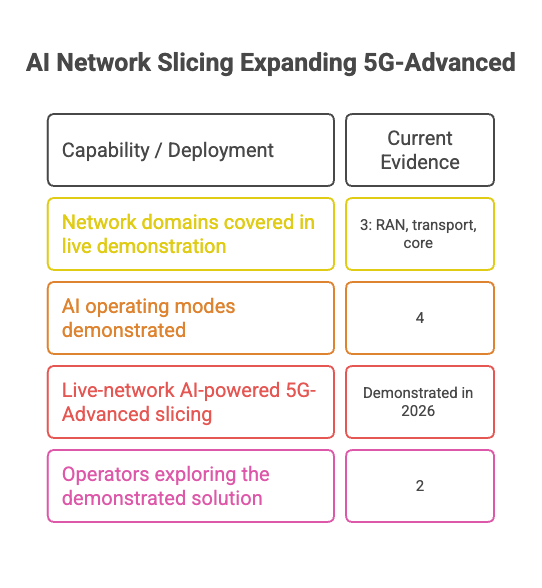
Key takeaway: Network slicing is evolving from a static virtualisation capability toward a more adaptive infrastructure layer that can respond to changing service and network conditions.
The change is therefore not about replacing network slicing with AI. It is about adding intelligence to the infrastructure that already performs the slicing, allowing 5G-Advanced networks to move closer to intent-driven and dynamically managed operation.