
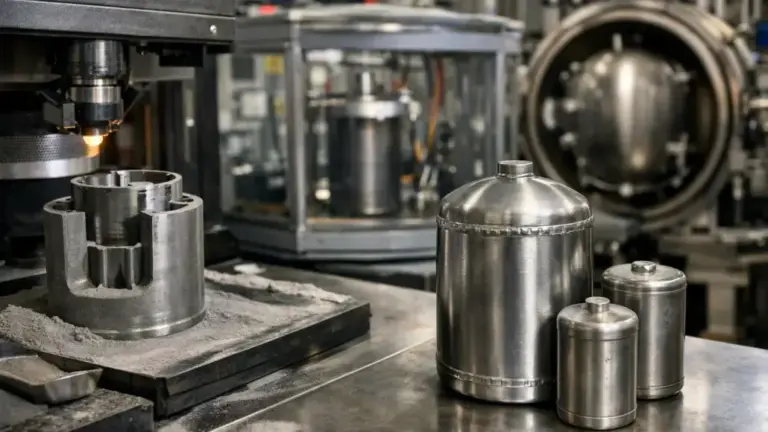
In a recent development, the scientists at the Oak Ridge National Laboratory – ORNL of the U.S. Department of Energy have collaborated with A.J. Tuck Company in order to develop a hybrid nuclear manufacturing process that integrates 3D printing and electroforming so as to create complex hot isostatic pressing – HIP cans.
It is worth noting that these sealed metal containers are where high-performance parts are made out of metal powders and that too under intense heat as well as pressure. The new method could make it easier to manufacture parts when it comes to advanced nuclear reactors and equipment, which are used in the energy and defence industries.
Interestingly, five cylindrical HIP cans were produced leak-free in initial tests, showing the method is indeed capable when it comes to producing accurate structures for powder metallurgy hot isostatic pressing. The research team has begun to move toward advanced geometries like an impeller or valve pertinent to the nuclear energy systems.
It is well to be noted that the research was conducted as per a cooperative research and development agreement and was accompanied by a licensing agreement with A.J. Tuck. The company supplied electroforming as well as metal-processing know-how and also performed the electroforming tasks as far as the project was concerned.
Apparently, the process could help grow domestic nuclear manufacturing capacity while at the same time also enable lowering the dependence on traditional forging and casting supply chains by way of creating complex metal structures and that too in a more direct way.
The innovation is under provisional patent and invention disclosure filing.
A new way to nuclear manufacturing
The hybrid nuclear manufacturing process comes as demand when it comes to specialized components from advanced as well as small modular reactors continues to see a rise.
The fact is that nuclear power accounts for about one-fifth of US electricity, but due to the lack of large-scale domestic forging along with casting capacity, it is a drawback on manufacturing.
Traditional manufacturing of major metal components can call for significant industrial infrastructure, numerous fabrication steps, and lengthy lead times.
Much of the capacity in the world for these processes is outside of the United States as well, which could as well make supply chains for strategically significant energy technologies very much vulnerable.
Notably, the ORNL approach seeks to overcome a few of these limitations by way of using additive manufacturing in conjunction with electroforming instead of depending solely on conventional metalworking.
How electroforming makes way for complex parts
It starts with a polymer mandrel or temporary form, which is made by a 3-D printer. This enables engineers to go ahead and design complicated structures that would be challenging, costly, or time-consuming to manufacture by employing traditional techniques.
The polymer form is then soaked in an electrolyte bath. Electroforming deposits nickel onto its surface, thereby creating a rigid, uniform metal shell that is 2-3 millimeters thick and that too in a very slow manner.
Once the shell is of the desired thickness, the polymer mandrel is then removed, hence rendering a hollow metal structure. The space is then filled with metal powder, and the container gets sealed and inserted into a HIP system.
The high temperature and pressure during HIP are used in order to consolidate the powder particles into a dense and solid component. The part obtained can hence be produced in a shape which is very much similar to its final geometry, thus eliminating multiple conventional fabrication and assembly procedures.
Less processing, more flexibility
There are also some manufacturing advantages to using polymer instead of metal when it comes to the initial 3D-printed form. This means that the plastic is not subjected to the high temperatures of metal additive manufacturing, and the possibility of thermal distortion and material stress throughout manufacturing is reduced.
The method also has the potential to minimize the equipment and material standards and enable fast changes to the design. There is also the potential for less post-processing compared to conventional metal additive manufacturing, which might as well go on to reduce development cycles for specialized components.
Direct integration of the HIP process port to the electroformed structure led to further improvement. This eliminates the requirement to weld separate process tubes to the container, which eliminates a possible breakdown point during high-pressure processing.
The first run went on to produce five cylindrical HIP cans, about 15 centimeters high and 10 centimeters in diameter, all of which were shown to be leak-tight.
Electroforming scaling for energy applications
Interestingly, electroforming has the advantage that the production time is mainly a function of the thickness of the metal deposit and not the size of the overall component.
This makes it possible for several parts to be made at the same time and could make the process attractive for larger parts.
Eventually, the technology could be used on components such as reactor pressure vessels, valves, and pumps, as well as turbine systems, where elaborate, highly precise metal structures are necessary.
The research is being carried out under a cooperative research and development agreement and subsequent licensing agreement with A. J. Tuck Company that provided the electroforming knowledge along with metal processing and carried out the electroforming work.
When it comes to the second phase, the manufacturing method is being applied to more challenging geometries.
The team will look at either an impeller, which is used to shift fluids in pumps and turbines, or a nuclear-relevant valve.
If this approach can be scaled effectively, the integration of 3D printing and electroforming could give nuclear manufacturers a more rapid and more adaptable route to generating specialized components, while at the same time reducing their exposure to limited conventional manufacturing supply chains.