
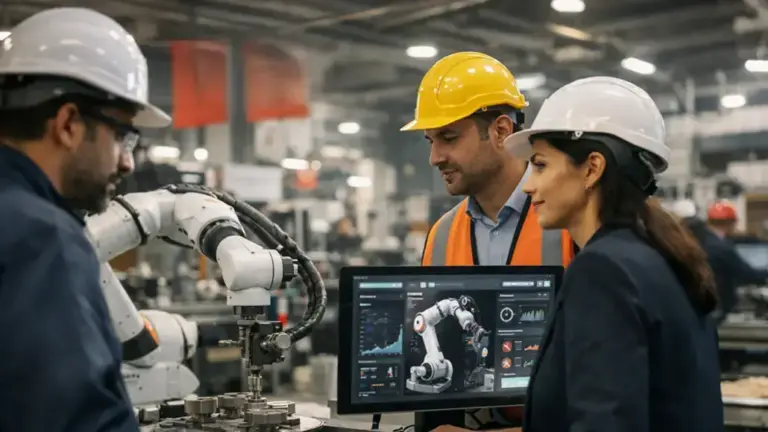
Data governance, not technology, is the biggest hurdle now for Turkish manufacturers to scale from AI pilots to enterprise-wide production, say GITEX Ai Turkey speakers.
The increasing role of AI in the US$608bn Manufacturing Sector of Turkey has the potential to create a major transformation in industrial output, with early adopters of the transformative technology already experiencing double-digit enhancements when it comes to efficiency and cost as well as quality, the industry experts said.
As per the World Bank Data, ‘AI-native production’ – the design of manufacturing processes from the ground up centered around core artificial intelligence systems – has begun to take shape throughout the Turkish industry, where manufacturing makes up a fifth of the gross domestic product – GDP of the country.
It is well to be noted that Türkiye’s top industrial transformation and capability development center, MEXT, evaluated over 200 Turkish manufacturers with its proprietary AI maturity methodology called AIxplore and has found that while maturity assessment differs across factories and sectors, Türkiye is progressing fast.
“The returns of AI-native production for early adopters are becoming increasingly measurable,” said the General Manager of MEXT, Efe Erdem, who is one of the 100-plus speakers at GITEX Ai Türkiye, which is the inaugural tech and AI event that is taking place on 9-10 September 2026 at Istanbul Expo Center. He adds that “Companies are improving production output by 10–20 percent, increasing employee productivity by 7–20 percent, reducing unplanned downtime by 10–30 percent, and lowering energy consumption by 5–15 percent.”
Erdem, who is going to take part in a fireside discussion on the future of AI-native production at GITEX Ai Türkiye, stated that the biggest wins in Turkish manufacturing occur when AI is integrated into basic company procedures, not when it is isolated as a technology experiment.
He further says that “we’ve seen AI deliver value way beyond the factory floor. In one project, an agentic AI solution reduced quotation processes that previously took days to just minutes, while improving pricing accuracy and responsiveness to customers.”
Another speaker on ‘The Intelligent Factory’ next month is the Director of Innovation and Digital Transformation at the Amman Chamber of Industry in Jordan, Lina Hushki who said that Turkish Lighthouse sites, a factory recognized by the World Economic Forum – WEF for effectively employing advanced digital technology, are also reaping huge rewards due to early AI adoption.
Hushki adds that “Arçelik’s Eskişehir factory, a Lighthouse site here in Türkiye, reports 20 percent fewer customer complaints from decisions supported by AI, 43 percent more capacity, and 17 percent lower conversion cost. These are real numbers from a real factory. But there are 238 lighthouse sites out of hundreds of thousands of factories, so these figures should be read as a direction rather than a promise.”
The technology is not the real constraint, data foundations are
Erdem, who will speak about the manufacturing industry’s AI maturity gap at the fireside chat ‘Beyond the AI Factory – What Is the Next Industrial Advantage?’ at GITEX Ai Türkiye 2026, said Türkiye is moving in the direction of AI-native production lines.
According to Erdem, “The biggest mistake is trying to scale too early. Many manufacturers launch multiple AI pilots simultaneously without proving measurable business value in a single process or putting robust OT data governance in place. Scaling AI is not just about deploying more models. It depends on trusted data, standardized processes, and strong governance across both IT and OT environments.”
He went on to further add that in Turkey, the automotive sector is leading the way when it comes to AI adoption along with machine vision and predictive maintenance. “White goods and electronics manufacturers are also progressing rapidly, largely because of their strong export orientation and exposure to global markets, where digital competitiveness, quality, and operational excellence are critical differentiators,” he added.
Jordanian Turkish Take when it comes to the Same AI Transition
Hushki, who heads AI-readiness work at the Amman Chamber of Industry, will provide comparative regional viewpoint to the GITEX Ai Türkiye panel: ‘The Intelligent Factory — From Industry 4.0 Pilots to AI-Native Production,’ presenting the model factory network of Türkiye as a template that other markets are attempting to imitate at a more modest level.
She highlighted vision-based quality inspection, predictive maintenance, energy optimization, and production planning, as well as digital knowledge systems, as feasible areas when it comes to the joint Turkish-Jordanian industrial partnership. The Manufacturing Sector of Turkey offers size, engineering expertise, and technology suppliers, she argued, while Jordanian firms provide fast-moving testing environments, specialized engineering expertise, and regional market access.
Hushki said that “Jordanian and Turkish manufacturers can work together through joint pilot projects, supplier development programs, applied research, and shared industrial AI solutions. Turkish companies bring manufacturing scale, engineering depth, and technology providers. Jordanian firms bring test environments that move quickly, specialized engineering talent, and access to regional markets.”
Defining the AI decade for Türkiye and Eurasia
Türkiye’s most international tech and AI event, GITEX Ai Türkiye, features a more comprehensive conference program, which includes the two sessions. Over 300 exhibitors and startups, 100 global speakers as well as 100-plus investors are expected to take part in the inaugural two-day event, drawing thousands of tech professionals from around the world and bringing together the emerging AI economy of Türkiye with global knowledge, capital, and commercial possibilities.
Among those who have given confirmation are global tech heavyweights powering the intelligence economy, such as the likes of Google Cloud, HPE & NVIDIA, Huawei, AWS, ASUS, Dell Technologies, SAP, and Schneider Electric, as well as TrendAI. Others are Türkiye’s $16.5 billion e-commerce giant, Trendyol, and also Andevos, the top AI and fintech platform of the country, along with Halkbank, which is the state-owned SME banking leader.