
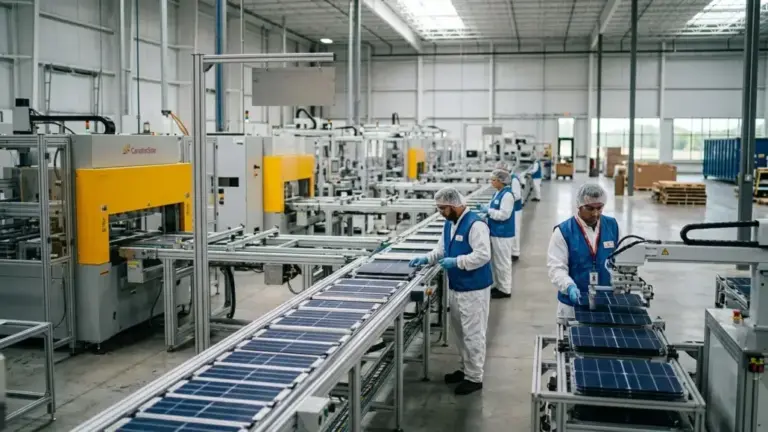
Canadian Solar has set up a solar cell production facility in Indiana on July 25, 2026, that, as per the company, is going to help address a major gap in U.S. solar manufacturing through producing a vital component that is mainly produced in Asia.
It is worth noting that the U.S. wants to create a domestic solar supply chain by means of tax incentives and trade measures to reduce its reliance on imports. China dominates roughly 80% of the global solar supply chain.
CS PowerTech, which is the U.S. manufacturing arm of Canadian Solar, is projected to produce 6 gigawatts of cells on an annual basis and employ over 1,200 individuals once it is completely operational early 2027, with an investment of almost $1 billion.
Colin Parkin, the Canadian Solar CEO, said in an interview that “for us this is a tremendous milestone”.
Canadian Solar is based in Ontario, Canada, and is one of the world’s largest manufacturers when it comes to solar equipment, with manufacturing facilities based out of China, South-east Asia, and the United States.
Interestingly, the Indiana plant located in Jeffersonville is the first U.S. facility built to manufacture heterojunction, or HJT, solar cells, a high-efficiency technology which, as per Parkin, will perform more effectively than traditional technologies and has more potential for future upgrades.
Notably, apart from the solar cell production facility in Indiana, the United States has added a lot of solar module assembly capacity since the Inflation Reduction Act implemented a tax credit for advanced clean energy manufacturing in 2022. Production of the cells which are assembled into panels, meanwhile, has slowed, forcing manufacturers to rely on imports.
The product resulting from the Jeffersonville plant will be utilised by the module factory of Canadian Solar in Mesquite, Texas, which is being enlarged to 10 GW of yearly capacity. It will directly cut down on their dependence on imported cells, Parkin said, although the business will still be relying on certain imports.
As per Parkin, the investment was justified by tariffs on solar imports and manufacturing incentives in the U.S. Manufacturing both cells as well as modules domestically enables the company to capitalize on the full worth of available tax incentives, he said.
He added that Canadian Solar is also keenly looking at investments further upstream within the solar supply chain.