
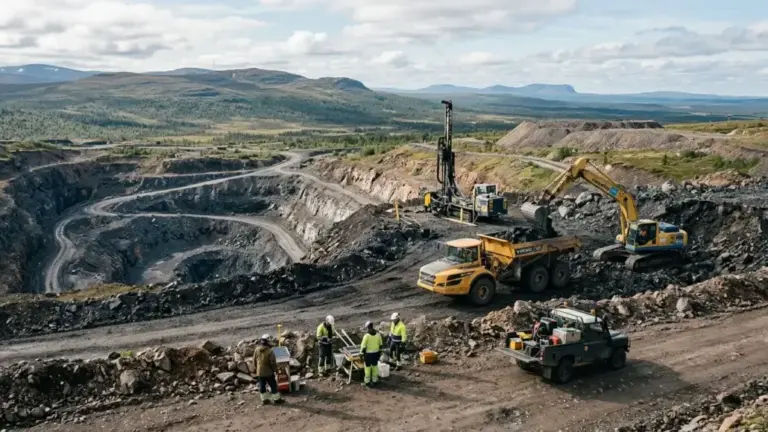
Sweden, on July 23, 2026, unveiled strategies to attempt to strengthen its mining sector, especially when it comes to rare earths, and combat European reliance on China.
It is well to be noted that resource-rich Sweden is already home to the biggest iron ore mine in Europe and has since discovered large, rare earth deposits at the same Arctic Circle site located in Kiruna.
The fact is that rare earth minerals are crucial for the production of renewable energy, defense and electric vehicle manufacturing, modern computer manufacturing, and various other critical industries. China does around 70% of the mining and refining in the world and it indeed makes sense to ease the permits for new mining projects in Sweden, which by the way is very rich in iron ore.
What did the government of Sweden say about the plan of action?
Mining of critical metals along with rare earth minerals was a matter of national security, the authorities in Stockholm said on July 23, 2026.
This ought to make it easier and faster to obtain permits for new mining projects and to draw in investments, said the minister of energy, Ebba Busch, who is also the deputy prime minister.
She said that Sweden must become a leading mining nation and outlined the new strategy, saying the government intended to streamline authorization procedures so decisions can be taken more quickly. She further added that “we believe that this can contribute significantly to Sweden’s, the EU’s, and NATO’s defense capabilities.” She termed the dependence of the European industry on China a systemic risk.
Busch also opined that the move would enable the state to distribute land for mining projects, a matter of contention with the indigenous Sami reindeer-herders who claim that the expansion of mining could lead to the end of their traditional way of life.
As per the energy minister, the government was considering establishing a state-owned investment company when it comes to the mining sector. She added that “Today, to put it plainly, the government lacks concrete tools to wisely contribute to accelerating and attracting investments in crucial strategic projects.”
What mining credentials does Sweden already have?
Interestingly, Sweden has been regarded as the European mining giant since the 10th century with the opening of the vast Falun copper mine, which at one time yielded nearly as much as two-thirds of the copper from the continent.
The disused mine is the reason for the unique deep red color, known as Falun Red, which is used in many houses, churches, and various other buildings in the country. Apparently, it is now a museum and a UNESCO World Heritage Site.
Modern-day Falun is the vast LKAB iron ore mine from Sweden in Kiruna, within the Arctic Circle. Sweden possesses approximately 60% of the known iron ore deposits of Europe, and in 2021 the country was responsible for roughly 90% of the iron ore production on the continent, and interestingly, around a third of that was from Kiruna alone.
The massive operation essentially undermines the city as well as Kiruna. It has hit the headlines lately owing to the need to relocate many homes and buildings, including the church, in the city due to subsidence.
Most of Sweden’s mines are located in the resource-rich and barely populated area of Norrland in Sápmi, the traditional land of the Sami. Over 90% of the mines on the continent are located in this area.
The Per Geijer find is an EU flagship project close to the Kiruna mine to minimize mineral dependence on China. In this region, some 1.2 billion tonnes of mineral resources have already been discovered, including a few 2.2 million tonnes of rare earth oxides.
One of the mining groups is exploring the deposit but believes it might take 10 years to get approval for excavation on Sami land.
Notably, Sweden has four of the 47 strategic projects of the EU to reduce its dependency on minerals from China.