
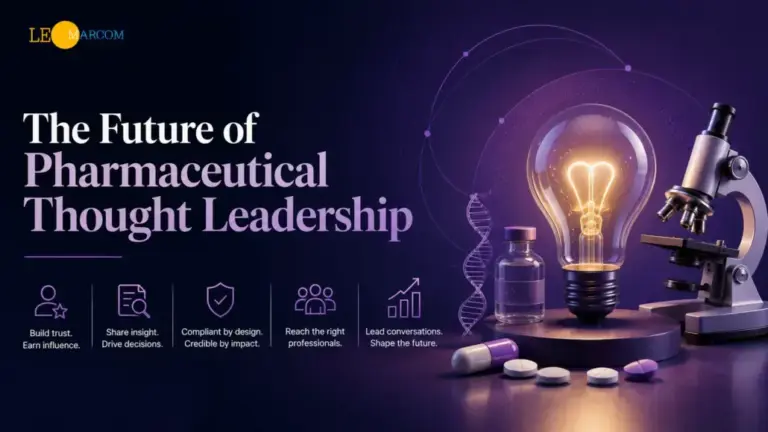
Pharmaceutical thought leadership is evolving at a pace that is fundamentally reshaping how pharma brands communicate expertise, build professional credibility and influence the decisions of the healthcare professionals, procurement heads and policy makers that drive their markets. In an industry where trust is non-negotiable and the consequences of poor communication are severe, the ability to lead industry conversations with genuine expert insight has never been more commercially important.
Consequently, pharma brands that invest in developing and distributing authentic thought leadership are building competitive advantages that their competitors cannot replicate simply by increasing advertising spend.
Why Pharmaceutical Thought Leadership Is More Important Than Ever
The pharmaceutical industry operates in one of the most complex and regulated communication environments in the world. Furthermore, the professional audiences pharma brands need to reach clinical directors, hospital procurement teams, pharmacy managers, healthcare administrators and medical researchers who are sophisticated evaluators who assess every communication through the lens of accuracy, expertise and genuine relevance to their professional reality.
Generic promotional content does not influence these audiences. Original expert insight that advances their professional understanding does. Therefore, pharmaceutical thought leadership is not a marketing tactic, it is the primary mechanism through which pharma brands earn the professional trust that drives long-term commercial relationships.
AI Is Raising the Bar for Genuine Expertise
The rise of AI-generated content is transforming the pharmaceutical thought leadership landscape in ways that simultaneously create challenge and opportunity. As AI tools make it easier to produce large volumes of technically plausible content, the professional audiences that consume pharma media are becoming increasingly skilled at identifying and dismissing content that lacks genuine depth, original research or authentic sector expertise.
Moreover, AI discovery systems are designed to surface content from sources that demonstrate consistent topical authority within defined subject areas rewarding pharma brands that publish genuine expert insight regularly and penalising those that produce volume without substance. As a result, pharmaceutical thought leadership in 2026 must be genuinely expert-driven, informed by real clinical knowledge, sector experience and original analysis rather than AI-assisted summarisation of existing consensus. World Pharma Today exemplifies this standard publishing pharmaceutical thought leadership that meets the rigorous expectations of the professional audiences who depend on it for real business and clinical intelligence.
The Platforms That Amplify Pharmaceutical Thought Leadership
Publishing expert content on owned channels reaches existing audiences — but the most impactful pharmaceutical thought leadership is distributed through trusted industry media platforms that reach the professional communities pharma brands most need to influence.
Therefore, pharma brands that contribute expert commentary, clinical analysis and market insight to established industry publications build a layer of third-party editorial credibility that owned content alone cannot deliver. HHM Global provides an additional dimension — connecting pharmaceutical brands with hospital and healthcare management professionals whose purchasing decisions directly impact pharma commercial outcomes. In addition, distributing thought leadership across both pharma-specific and healthcare management platforms ensures expert content reaches the full spectrum of decision-makers involved in pharmaceutical procurement and partnership decisions.
Compliance and Credibility Must Coexist
One of the defining challenges of pharmaceutical thought leadership is navigating the tension between regulatory compliance and genuinely engaging expert communication. Furthermore, content that is technically compliant but editorially dry fails to capture the professional attention it needs to build authority while content that prioritises engagement at the expense of compliance creates serious regulatory and reputational risk.
The most effective pharmaceutical thought leadership in 2026 resolves this tension by treating compliance as a framework for clarity rather than a constraint on communication. Pharma brands that communicate compliantly and compellingly using regulatory requirements to sharpen rather than dilute their expert messaging build the kind of professional credibility that sustains long-term audience relationships.
Conclusion
Pharmaceutical thought leadership is evolving from a marketing support function into a core business strategy — one that builds professional trust, shapes industry narratives and creates the kind of long-term brand authority that drives sustainable commercial growth in one of the world’s most competitive and regulated industries.
At Leo MarCom, we help pharmaceutical and healthcare brands develop and distribute the expert thought leadership that reaches the right professional audiences and builds lasting industry authority. Subscribe to our newsletter to get the latest industry updates.