
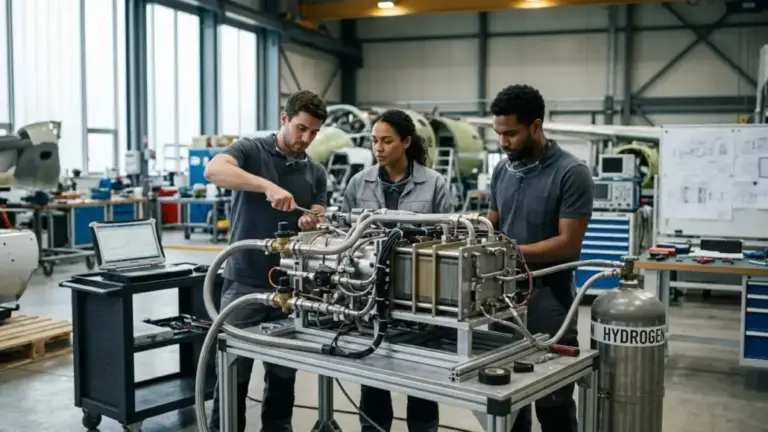
Airbus, along with MTU Aero Engines, is looking to strengthen its partnership with a joint venture to develop and commercialize a fully electric hydrogen fuel cell engine. This anticipated milestone follows up on the Memorandum of Understanding – MoU that was signed by the two companies at the Paris Air Show in June 2025.
The partners seek to speed up the advancement of technology, testing, design, and certification of a groundbreaking hydrogen-based fuel cell propulsion system for aviation via the creation of an exclusive and extremely flexible organizational setup. Airbus and MTU will assist the newly formed company with all their skills and via multiple engineering and manufacturing teams from both organizations.
This non-binding agreement is contingent upon normal regulatory permits and the finalization of social processes at both the European as well as national levels. The new joint venture is scheduled to go live in 2027.
According to the head of Airbus Future Programmes, Bruno Fichefeux, “Our planned joint venture is the next logical step in our shared vision of a hydrogen-based propulsion concept for aviation. By pooling our respective technology and expertise into a dedicated entity, we are establishing a European powerhouse capable of transforming advanced research into industrialized, certifiable electric propulsion systems. This new company will help secure strategic sovereignty in the next generation of aviation technologies while strengthening our ability to achieve the long-term ZEROe ambition.”
According to the SVP of Engineering and Technology at MTU Aero Engines, Dr. Stefan Weber, “Our ambitious goal is to pave the way for a newly developed, safe, reliable, and economical propulsion system that will contribute to climate-neutral aviation. This project is a crucial milestone on our path to the first hydrogen-powered engine – and this is true European technology leadership. To that end, we want to create a company that covers the entire life cycle of fuel cell powertrains – from development and testing through certification to commercialisation.”
It is well to be noted that hydrogen has what it takes to make a significant contribution in terms of diminishing the climate impact when it comes to aviation in the long term and to also make adequate transformation in air transport in a much similar way to the effect of electric vehicles when it comes to the automotive sector.
The joint venture is based on the common goal of both partners to establish a technology leader in this domain and bring the first hydrogen-based fuel cell propulsion system to a commercial plane. It will pair the extensive experience of commercial aircraft programmes, substantial fuel cell propulsion as well as liquid hydrogen experience by Airbus with multi-year development of fuel cell technology along with its acknowledged engine design, standard integration, validation and certification, and maintenance experience of MTU.
In addition to the engine technologies, both Airbus and MTU will keep pushing for the development of a hydrogen aviation economy and the corresponding regulatory framework, which also serve as crucial enablers for the emergence of hydrogen-powered flight at a global level.