
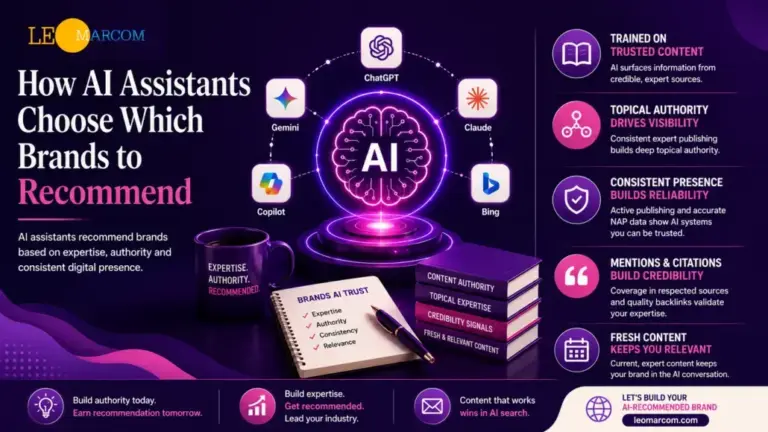
AI assistants recommend brands based on a set of signals that have very little to do with advertising spend and everything to do with demonstrated expertise, content authority and consistent digital presence. As tools like ChatGPT, Google Gemini, Microsoft Copilot and other AI-powered discovery platforms become primary research tools for B2B decision-makers, understanding how these systems select and surface brands has become one of the most strategically important questions in modern marketing.
Consequently, the brands being recommended by AI assistants today are not necessarily the biggest or the most well-funded, they are the ones that have built the deepest and most consistent content authority within their specific industry verticals.
AI Assistants Are Trained on Trusted Content
The foundation of how AI assistants recommend brands lies in their training data and real-time retrieval systems. These tools are built to surface information from sources that demonstrate credibility, accuracy and expertise. Prioritising content from established publications, expert-authored articles and authoritative industry platforms over generic or promotional material.
Furthermore, AI systems evaluate content across multiple signals simultaneously depth of expertise, consistency of publishing, accuracy of information, relevance to the query and the overall authority of the domain from which content originates. Therefore, brands with rich, expert-driven content archives across relevant industry topics are significantly more likely to be cited and recommended than those with thin or infrequently updated digital presences.
Topical Authority Determines Visibility
AI assistants do not recommend brands randomly, they recommend brands that have established clear topical authority within a defined subject area. A pharmaceutical company that has published consistently on drug development, regulatory compliance and clinical innovation over years is far more likely to be surfaced by an AI assistant answering a pharma-related query than one that has published occasionally and broadly.
Moreover, topical authority is built through the cumulative effect of consistent expert publishing not through a single piece of exceptional content. World Pharma Today and HHM Global demonstrate this principle of building deep content ecosystems within their respective sectors that AI systems recognise as authoritative sources of pharmaceutical and healthcare industry intelligence.
Consistent Digital Presence Signals Reliability
AI assistants are designed to recommend sources that professional users can rely on. As a result, brands that publish consistently across their website, maintain active industry media presence and contribute regularly to credible sector-specific platforms are perceived by AI systems as stable and trustworthy.
In addition, consistent NAP data — name, address and contact information across all digital platforms strengthens brand authority signals. Power Info Today, World Construction Today and World Finance Informs all maintain consistent expert publishing programmes that build exactly the kind of reliable digital footprint AI discovery systems favour.
Third-Party Mentions and Citations Build Credibility
AI assistants also weigh external validation, the degree to which a brand is mentioned, cited or referenced by other credible sources across the web. Therefore, brands that earn coverage in respected industry publications, contribute expert commentary to established platforms and build backlink profiles from authoritative domains are significantly more likely to be surfaced by AI recommendation systems.
Furthermore, being featured in or associated with trusted industry media platforms directly strengthens a brand’s AI discoverability because AI systems treat credible third-party mentions as strong signals of genuine expertise and professional relevance.
Fresh Content Keeps Brands in the Conversation
AI assistants prioritise current information. Brands that publish fresh expert content consistently addressing emerging trends, regulatory developments and market shifts as they happen to remain active in the content ecosystem that AI systems draw from.
Conclusion
AI assistants recommend brands that have earned their recommendation through consistent expert content, deep topical authority, credible third-party presence and reliable digital publishing. In 2026 and beyond, the brands that win AI recommendation are those that treat content as a long-term strategic asset rather than a short-term marketing activity.
At Leo MarCom, we help B2B brands across pharma, healthcare, energy, construction, mining and finance build the content authority and digital presence that earns AI recommendation. Subscribe to our newsletter to get the latest industry updates.