
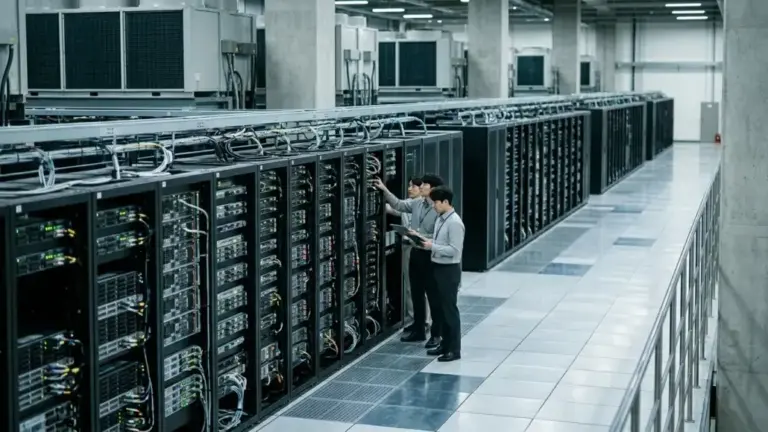
SK Telecom declared on July 5, 2026, that it intends to build an AI data center with a footprint of a maximum of 15GW. The objective is to be the AI infrastructure hub in Asia.
The move aims to aggressively build up local AI computing facilities at a time when there is enormous demand for AI model training and inference, and high-performance computing systems is essential for national competitiveness.
It is well to be noted that SKT is taking charge of the project by connecting it with the government’s AI G3 strategy with the objective of becoming one of the three top AI powers in the world along with the U.S. and China and the mission of balancing regional growth. It is analyzing thoroughly core infrastructure components like power and siting as well as operations for the AI data center.
Ulsan AI Data Center to be scaled up to GW Scale – 5GW to be activated in stages from 2029 for a total of 15GW
A standard AI data center of 1GW class might need a significant project cost of roughly 70 trillion Korean won because of the construction of high-performance AI computing infrastructure as well as skyrocketing memory prices.
Such costs are anticipated to be borne by the company’s own investment, strategic partner investment, and long-term customer contracts, as well as project financing of the company.
The context for SKT’s decision to construct an AI data center of this magnitude is a worldwide shortage of supply. Global demand when it comes to data centers will grow 19–22% each year, and supply is unlikely to keep up.
As per McKinsey & Company, the global consulting firm, the U.S. alone will encounter a projected shortage of approximately 15GW by the end of the decade.
Therefore, global big tech companies are raising investment in data centers far away from the U.S. to places around the world. In this regard, Korea has attracted the interest of global big tech companies as a potential investment location for AI data centers.
The fact is that Korea remains highly competitive when it comes to core AI components like high-bandwidth memory – HBM. Moreover, the steady power supply conditions centered around nuclear power as well as liquefied natural gas – LNG and the GW-class infrastructure operation resources gained by means of operating semiconductor fabs serve as an attractive site for AI data center and the aim of becoming an AI infrastructure hub in Asia by SK telecom is indeed not a long shot.
Demand is high, location is favorable, and SKT intends to build 15 GW of AI data center capacity.
First, commencing with the AI data center being constructed in Ulsan, SKT will establish a cluster of over 2 GW in the southeastern region – Gyeongsang and utilize it as a basis to draw demand for AI infrastructure coming from global big tech companies to Korea.
It also looks forward to another 1 GW in the southwestern region at Jeolla so that its AI data centers, established in 2029 and beyond, will have 5 GW of overall domestic capacity.
SKT will take into account multiple variables, including site selection and power supply as well as securing essential anchor tenants in tandem in accordance with the balanced regional development tasks and strategic supply plans of the government so as to pursue AI data center construction.
SK Group has comprehensive AI infrastructure capabilities with SKT to take overall project leadership as AI Infrastructure Architect
The three main foundations of AI data center infrastructure are semiconductors, energy solutions as well as data center construction and operation capabilities. SK Group demonstrates these core capabilities across all of its affiliates. This project will put together the group’s complete AI infrastructure, taking advantage of the capabilities of every affiliate.
Particularly, SKT will take the crucial position of overseeing the design, construction, and operation of the AI data centers. SKT had already been active in the AI data center business and proceeded to collaborate with global big tech companies.
In November 2025, SKT President and CEO Jung Jai-hun at the SK AI Summit 2025 laid out the AI infrastructure roadmap of the company, declaring that SKT would spearhead the evolution of AI infrastructure as the top AI operator in the nation. He additionally laid out a long-term plan to strengthen cooperation with global big tech companies and to boost the size of the Ulsan AI Data Center to a total exceeding 1GW.
Recently, SKT announced plans for an AI Factory, which it defined as a next-generation AI data center. SKT plans to open the AI Factory in 2027 and increase its capacity to GW scale in the future.
Third National Infrastructure Revolution of Korea after Gyeongbu Motorway, High-Speed Internet
It is worth noting that the AI industry anticipates AI data centers becoming not just a new growth engine for Korea but also a national strategic resource. More specifically, it is likely that connecting AI data centers to regional industries is going to contribute toward balanced regional development.
The construction is anticipated to act as a catalyst for Korea to develop into an AI infrastructure hub with the 15GW-scale AI data center. SKT considers AI data centers the third innovative infrastructure in Korea after the Gyeongbu Motorway – 1968 and high-speed internet – 1998 and plans to guide its development.
According to the President and CEO of SKT, Jung Jai-hun, “This AI data center project is aimed at preemptively preparing the computing infrastructure that the global AI ecosystem needs. We will work closely with the government, industry, and local communities to help Korea grow into Asia’s core AI infrastructure hub.”