
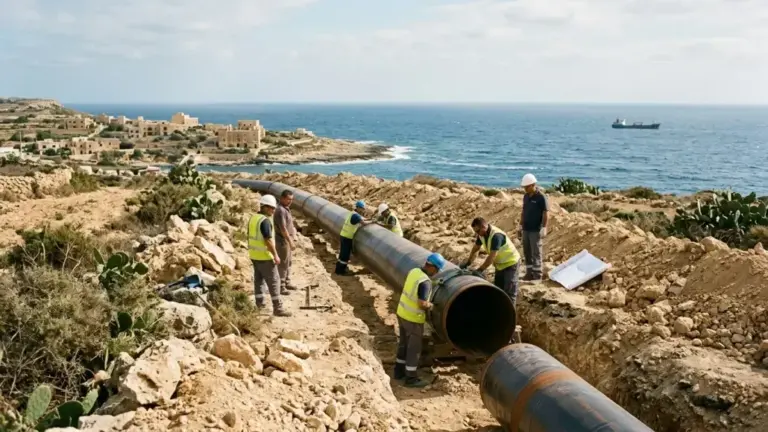
European Union member states have backed a move by Malta to broaden a unique exemption that keeps the proposed hydrogen-ready pipeline project in Malta qualified for potential EU financing.
The decision was taken at a meeting of EU energy ministers in Luxembourg, where the Council of the European Union confirmed its position in negotiations for amendments to the Trans-European Networks for Energy—TEN-E regulation. The proposal now proceeds on to formal discussions with the European Commission and European Parliament before its ultimate approval.
The exemption, announced by the Ministry for Energy, Environment, and the Regeneration of the Grand Harbour of Malta, means the hydrogen-ready pipeline project in Malta will keep its status as a Project of Common Interest – PCI, making it a candidate for financing via the Connecting Europe Facility.
Miriam Dalli, the energy minister, said the decision recognizes Malta’s geographical obstacles and encourages the country’s long-term energy transition.
She adds that “This is an important step forward for Malta, reflecting our country’s geographic realities while remaining aligned with the government’s long-term strategy to decarbonize the power sector by 2050. We have secured the Council’s support for the continued eligibility of the hydrogen-ready pipeline project for potential EU funding. This keeps open Malta’s future access to the EU hydrogen backbone and the developing hydrogen market.”
It is well to be noted that the exemption was initially granted in 2021 and enabled the Maltese pipeline project to be listed on the European Union’s 2023 and 2025 lists of Projects of Common Interest, regardless of the island nation having no direct links to the continental gas network.
The Council said the prolongation corresponds to the ongoing physical separation of Malta and Cyprus from the trans-European natural gas network and the potential European hydrogen backbone. EU member states concurred that pipeline interconnections for the two island countries remain a significant objective, as long as such standard infrastructure does not hinder the adoption of renewable energy or wider decarbonization initiatives.
The energy ministers from the EU also agreed on a negotiating stance to speed up the approval of renewable energy projects and talked about the long-term energy targets along with regional energy security of the bloc during the same meeting.