
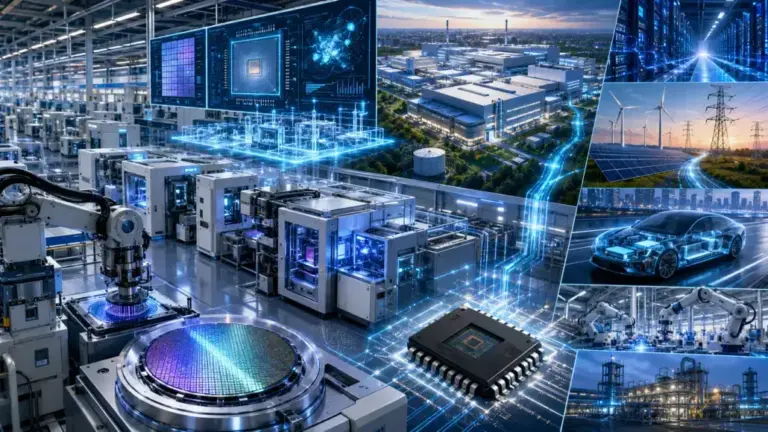
Smart Power Fab from Infineon Technologies in Dresden, Germany, has gone into regular operation months ahead of schedule. The largest power semiconductor fab in the world when it comes to intelligent power semiconductors and analog/mixed-signal technologies is now operational.
The plant symbolizes the biggest investment by the company ever at €5 billion or $5.7 billion. It will create 1,000 direct jobs and double the capacity of Dresden’s manufacturing facility from Infineon.
The factory will manufacture chips that boost the conversion and management of electricity. These devices will be supplying electricity to AI data centers. They will also power electricity grids as well as software-defined vehicles.
Dresden’s capacity increased to 2x
The largest power semiconductor fab in the world massively increases the production capacity of Infineon at the Dresden site, which is one of the most important production sites of the company. The extra capacity is coming online as demand is growing for power semiconductors throughout a variety of sectors.
According to Jochen Hanebeck, the chief executive officer, the investment comes at an apt time because industries need more power chips when it comes to future technologies.
He adds that “Our Smart Power Fab is creating urgently needed capacities for the key technologies of the future.” The facility will help bolster supply chains that support critical industries, he said.
Friedrich Merz, the German chancellor, said that the project was indeed a solid signal for the semiconductor industry in Europe. He said Germany can still compete in chip manufacturing. Power semiconductors, as per him, also play a critical role as far as AI infrastructure along with energy transition is concerned.
AI accelerates production
The factory is equipped with digital manufacturing equipment that minimizes production delays and speeds up capacity expansion if demand rises. Engineers created a digital twin to improve the building configuration and machinery placement before its construction began.
It is well to be noted that artificial intelligence assists in process qualification along with production planning. Those technologies, according to the company, can speed up production growth by a factor of two over previous manufacturing lines.
Apparently, the Dresden site is also linked to the Infineon manufacturing site located in Villach, Austria, via its One Virtual Fab network. Engineers can more rapidly validate new products and manufacturing procedures when it comes to both facilities.
A quicker qualification procedure could reduce the time lag between product development and large-scale manufacturing. As demand for electricity grows, such flexibility is becoming more essential. As AI infrastructure expands, chipmakers also encounter pressure to speed novel designs into manufacturing.
Chips produced in Dresden are able to handle and regulate electrical power more effectively. Some will boost up power supplies inside AI data centers while others are going to endorse wind turbines and solar installations as well as industrial equipment. The factory will also make chips for software-defined vehicles. Intelligent power switches have the capacity to track power flow and to switch between loads more effectively.
Sustainability remains key
Infineon also created the new fab to minimize its environmental impact in harmony with the production growth. The facility does not run on natural gas. Closed-loop water systems recycle 90% of process water. The design captures as much as 45% of the energy utilized when making it, the company says.
The investment further solidifies the position of Dresden in Silicon Saxony, the largest semiconductor cluster in Europe. Already over 80,000 people are working in the region’s ecosystem. Finally, the new fab is expected to create more jobs by means of its suppliers and assisting industries compared to the 1,000 it will directly hire.
The rise in AI infrastructure and electricity demand is driving the growing importance of power semiconductors. The new Smart Power Fab further expands the manufacturing capacity in the portfolio of Infineon and strengthens the role of Europe when it comes to advanced semiconductor manufacturing. The funding is also a reflection of a wider effort across Europe to boost domestic chip manufacture and decrease reliance on global production for key strategic technologies.