
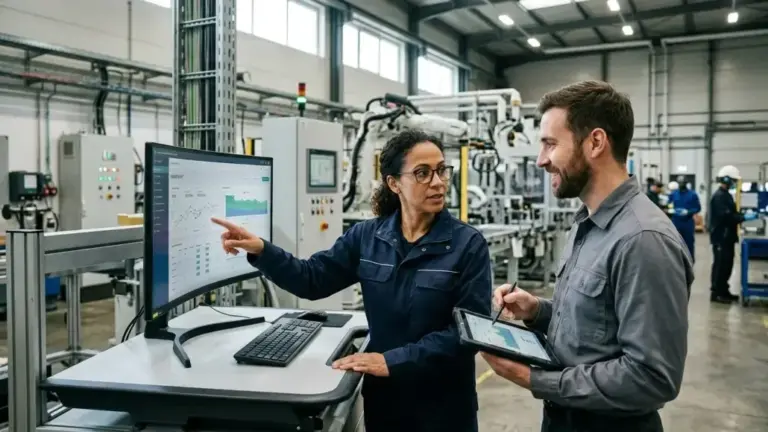
Siemens has joined forces with IFS to equip factories with industrial AI and hence connect engineering and operational data throughout the entire product lifecycle.
The partnership brings together the strengths of Siemens in industrial AI, engineering, and automation as well as manufacturing execution and the strengths of IFS when it comes to industrial AI, enterprise asset management, as well as field service. The partnership is intended to close the gaps between factory design along with everyday operations, such as unexpected downtime, disconnected maintenance plans, siloed production data as well as supply chain disruption.
Emphasis on manufacturing operations
Manufacturers are under constant pressure in order to lift output from current assets, manage profits, expand equipment life, and react faster to shifting situations. There are many who still make use of separate systems for manufacturing, maintenance scheduling, and supply chain management, which may restrict coordination between engineering and operations as well as service.
Industrial AI position
Industrial AI is at the heart of the partnership. The idea is to link design data along with operational performance data, so manufacturers can evaluate engineering plans against real-world conditions of operation and feed the results into future design and production choices.
The digital twin technology from Siemens gives engineering, simulation, and manufacturing context, and IFS offers service level history, performance of assets, and lifecycle data. These inputs collectively aim to facilitate a digital twin for linking design intent to field performance via design, service records, and simulation as well as factory execution.
So as to equip factories with industrial AI, a major criterion is that Industrial AI systems for manufacturing must fulfill benchmarks in precision, dependability, compliance with regulations, and ability to adapt, since decisions may impact safety, compliance, and tangible assets.