
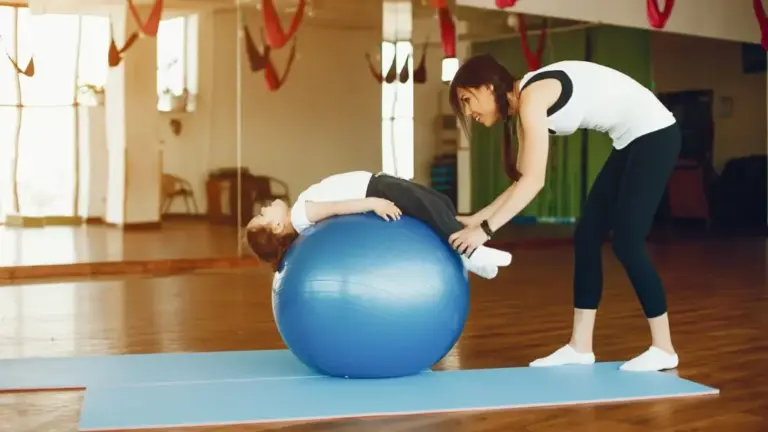
Building motor skills, strength, and efficient movement
Physical therapy (PT) addresses gross motor skills the large movements that allow a person to walk, run, climb, sit, stand, and move through the world. Not all autistic individuals have motor challenges. Many autistic people have typical or even advanced motor coordination. However, some autistic people have significant motor differences: low muscle tone, poor balance, awkward coordination, inefficient movement patterns, or difficulty with movement planning. For these individuals, physical therapy can be genuinely transformative.
Motor Differences in Autism: Why They Matter
Some autistic children are clumsy: they trip, bump into things, have difficulty with stairs or playground equipment. Some have low muscle tone (hypotonia) that makes them look ‘floppy’ and affects their ability to sit upright or sustain postures. Some have difficulty with movement planning (dyspraxia): knowing intellectually how to do something but being unable to get their body to do it. Some have peculiar movement patterns: unusual gait, toe-walking, or asymmetrical movement.
These motor differences are not just about physical limitation. They affect social participation (can’t keep up on playground, can’t climb playground equipment). They affect academic learning (difficulty sitting still, holding pencils, writing). They can be a source of embarrassment and social isolation. When motor skills improve, quality of life often improves dramatically.
What Physical Therapists Address
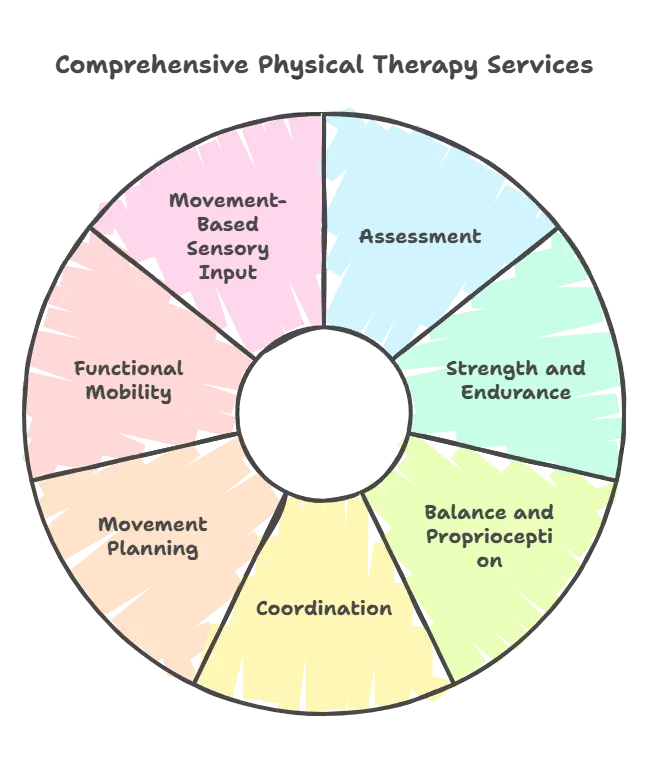 Assessment: thorough evaluation of strength, balance, coordination, movement patterns, and functional mobility.
Strength and endurance: building the muscle strength needed for sitting, standing, walking, climbing, and other activities.
Balance and proprioception: awareness of body in space and ability to maintain balance.
Coordination: smooth, efficient movement; ability to cross midline; bilateral coordination.
Movement planning: practice with repeated movement patterns to improve automaticity.
Functional mobility: ability to move safely and efficiently throughout daily environments.
Movement-based sensory input: for individuals who seek intense proprioceptive or vestibular input.
Physical Therapy and Sensory Needs
For some autistic individuals, physical activity serves a sensory function. Children who engage in intense crashing, jumping, or rough play are often seeking proprioceptive input the feedback from muscles and joints about where the body is in space. Rather than simply limiting this behaviour, physical therapists can channel this need into organised, safe activities: jumping on a trampoline, playground time, resistance activities.
When these sensory needs are met through PT, behaviour often improves and the child is better able to regulate.
Finding a PT Experienced in Autism
Look for physical therapists who:
- Have experience assessing and treating children with motor differences related to autism
- Are willing to adapt activities to the child’s interests and sensory preferences
- Work in natural environments (school, playground, community) when possible
- Can explain the motor differences they are addressing and the rationale for treatment
- Collaborate with the family and school around functional goals
Important recognition: Motor differences in autism are real and deserve attention. Just because a child’s primary challenges are social and communicative does not mean motor differences should be ignored. Improving motor skills opens doors to participation, independence, and confidence.
Key Takeaway
Physical therapy addresses gross motor skills, balance, coordination, and movement efficiency. For autistic individuals with motor differences, PT can enable greater participation in school, play, and community life.