
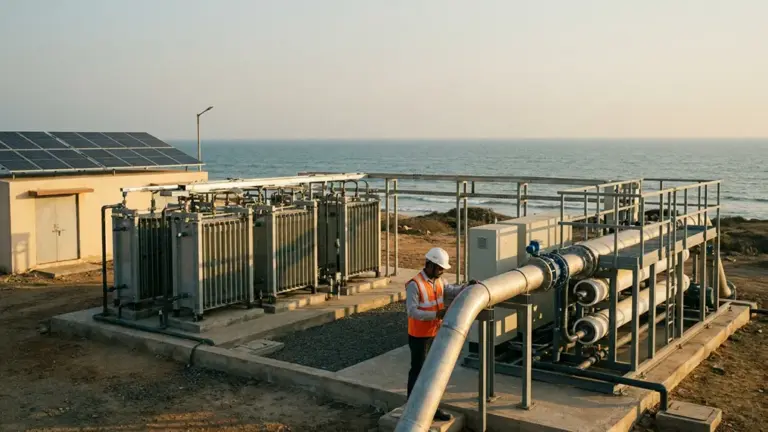
The Ministry of New and Renewable Energy – MNRE has gone ahead and issued comprehensive instructions on the quantification of greenhouse gas – GHG emissions related to off-site water drawal and treatment procedures for green hydrogen production in India. The guidelines, released on 18 June 2026 by Director Prasad A. Chaphekar, constitute a component of the Green Hydrogen Certification Scheme of India – GHCI And are in sync with ISO 19870:2023, the global standard.
The new structure pertaining to green hydrogen production In India is intended to introduce a common methodology for the calculation of emissions in the context of the well-to-gate boundary when it comes to hydrogen production. The guidelines state that emissions from direct withdrawals of raw water coming from natural sources like rivers, lakes, or seawater are not included. However, in order to properly assess the carbon intensity, emission levels resulting from water treatment, transportation, and associated energy consumption have to be taken into account.
MNRE has developed five standardized operational scenarios to suit various water sourcing configurations. Scenario A pertains to hydrogen producers who own and manage offsite captive water treatment plants. They are required to use basic metered data for emissions calculations, and any claim on renewable energy requirements has to be substantiated with valid evidence like load dispatch certificates. Such claims cannot be made with Renewable Energy Certificates – RECs.
Scenario B applies to water supplied by municipalities or state agencies. In such instances, standard emission benchmarks will be applied until the utility can offer verified evidence that the water supply is fueled completely by renewable energy. Scenario C pertains to jointly owned or shared treatment infrastructure with emissions allocated to the users based on the amount of water they consume.
Scenario D pertains to the use of recycled water or treated wastewater. For these projects, the emission boundary starts at the plant gate of the manufacturer and only encompasses the extra energy used for final water polishing and processing for electrolysis. Scenario E concerns hybrid systems with multiple water sources, where producers must keep daily records and compute a weighted average emission factor.
For ease of implementation, MNRE has notified default emission factors based on data gathered from the Central Electricity Authority – CEA and other international references. The guidelines predict an all-India weighted average grid emission factor of 0.710 kgCO2e/kWh and a standard transmission and distribution loss factor of 17.63%. Under these assumptions, the default emission factors are 3.017 kgCO₂e/m³ for seawater desalination, 0.603 kgCO₂e/m³ when it comes to municipal surface water treatment, and 0.388 kgCO₂e/m³ for recycled water polishing.
The guidelines usually exclude the incorporation of chemical inputs in treatment processes, provided that the contribution they make is greater than 0.02 kgCO2e per kilogram of hydrogen generated. Further, all critical metering equipment shall be calibrated annually by NABL-accredited laboratories.
For execution, new facilities commissioned have 90 days to put monitoring systems in place, while current facilities have 180 days to come into compliance. Producers are required to report to the verification agencies without delay in case of metering failures or force majeure, and conservative benchmarks are used until regular monitoring is re-established. These steps are to enhance openness, consistency, and trustworthiness in the green hydrogen certification framework of India, the ministry stated.