
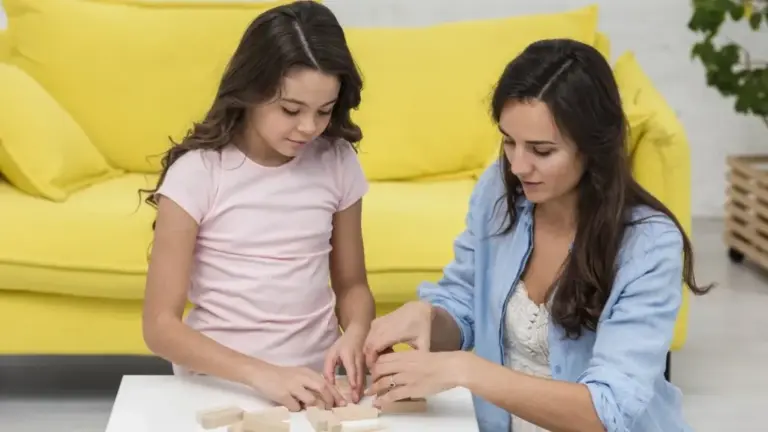
Building the bridge between self and other through shared focus
Joint attention is the ability to share focus on an object or experience with another person to look at a butterfly, then look back at a parent to share the delight, then look at the butterfly again. This seemingly simple ability is one of the strongest predictors of language development, social skills, and later academic success in autism. When it is delayed or absent, it opens a window into how the autistic child’s social brain is developing differently. And when it becomes a target of intervention, improvement in joint attention often cascades into improvements in language, play, and social learning.
Understanding Joint Attention
 Joint attention has two forms. Responding to joint attention (RJA) means following someone else’s gaze or point to look at what they are looking at. If a parent points to a bird and the child looks where the parent is pointing, that is RJA.
Initiating joint attention (IJA) means drawing someone else’s attention to something in order to share the experience. A toddler holds up a toy to show it to a parent. A child points to a plane in the sky and looks back to see if the adult noticed. These are initiations of joint attention, and they are more specifically linked to language development.
In autism, particularly the initiation of joint attention is often reduced or absent. A child may be absorbed in objects, but they rarely share that absorption with another person. This is not about motivation or attachment; it reflects a difference in how the social brain prioritises information.
Why Joint Attention Matters for Development
Words are learned within joint attention moments. When both child and adult are looking at the same thing, and the adult labels it (‘Look, a dog!’), the child can connect the word to the referent. Without joint attention, this word-mapping process is disrupted.
Beyond language, joint attention is the foundation of shared understanding and empathy. It is the beginning of recognising that other minds exist, that other people pay attention to things, and that we can share experiences. Children who lack joint attention miss thousands of these early experiences.
Joint Attention Therapy: What It Looks Like
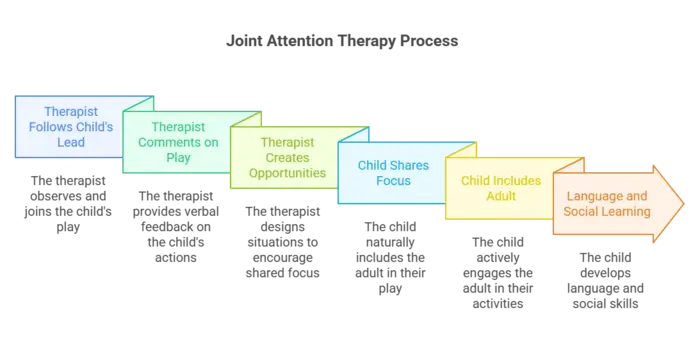
Joint attention therapy is fundamentally play-based. A therapist or parent follows the child’s lead, joins their play, comments on what they are doing, and gradually creates opportunities for the child to look back and forth between the adult and the object or activity.
For example, if a child is spinning a toy wheel, the therapist might sit beside them, comment (‘Spinning! Round and round!’), briefly block the wheel, look at the child’s face, and release it. This creates a natural moment where the child is invited to share focus: ‘Look what happened! I made it stop!’
Over many interactions, the child begins to naturally include the adult in their play. They look to the adult’s face when something interesting happens. They show the adult their toys. They pause in their activity to see if the adult is watching. When this shift happens, language and social learning often follow.
Effectiveness and Evidence
Research shows that children who receive targeted joint attention intervention show improvements not just in joint attention itself, but in language, social reciprocity, and play. Improvements are particularly strong when intervention begins early (before age three) and is intensive.
The beauty of joint attention intervention is that it works through the natural mechanism of play and social interaction, not through forced compliance. When done well, it feels like fun, not therapy.
Important principle: Joint attention therapy works by following the child’s lead and making it rewarding to include adults in their interests. It is not about forcing eye contact or demanding attention. It is about creating moments where sharing focus feels natural and pleasurable.
Key Takeaway
Joint attention the ability to share focus and experience with another person is foundational for language and social development. When targeted in early childhood intervention, improvement in joint attention often leads to cascading benefits across language, play, and social domains.