

Comprehensive support within the learning environment
Once a child enters school, the educational environment becomes central to their development. For many hours each day, the child is in a social, academic, and sensory environment that may be significantly challenging for an autistic person. Educational and school-based therapies work within this environment to provide support, accommodations, and instruction tailored to the autistic student’s needs. These services are coordinated through an Individualized Education Programme (IEP) and are legally mandated under the Individuals with Disabilities Education Act (IDEA).
The IEP: The Foundation of School Support
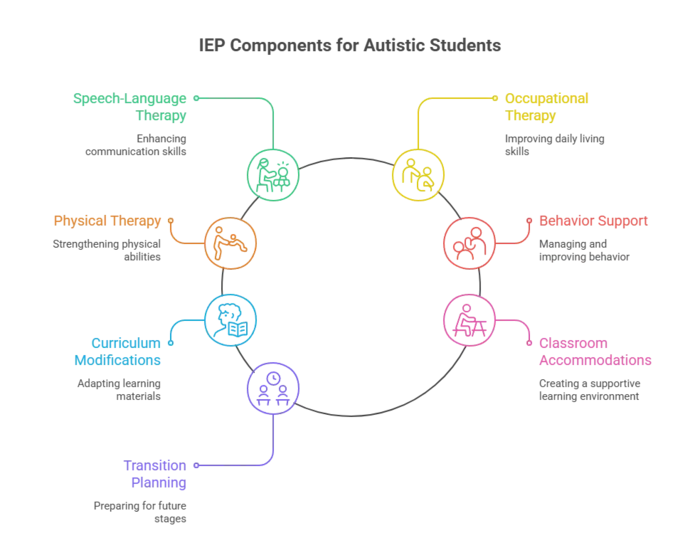 An Individualized Education Programme (IEP) is a legal document that outlines the special education and related services a student will receive. For an autistic student, the IEP might include:
- Speech-language therapy
- Occupational therapy
- Physical therapy
- Behaviour support services
- Modifications to curriculum and instruction
- Classroom accommodations (sensory breaks, visual supports, modified assignments)
- Transition planning (as the child approaches graduation)
The IEP is developed collaboratively with the family, school staff, and (as appropriate) the student themselves. It should be based on thorough assessment and clear, measurable goals. Goals might include academic skills, social communication, independence, or behaviour whatever will most support the student’s success.
School-Based Therapy Services
Speech-language pathology, occupational therapy, and physical therapy are commonly provided in schools. These services might be delivered in pull-out sessions (the student leaves the classroom for therapy) or in integrated sessions (the therapist works with the student within the classroom and daily routines).
Modern best practice favours integrated, consultative approaches. Rather than removing the student from the classroom, the therapist works within the classroom and routines, coaching the teacher and other students on how to support the student’s goals. This approach is more effective because it allows skills to be practised in natural contexts and integrated into daily classroom life.
Environmental Design and Accommodations
One of the most important aspects of school-based support is the physical and sensory environment. For many autistic students, the typical school environment fluorescent lights, noise, crowding, unexpected changes, social chaos is profoundly overwhelming.
Accommodations might include:
- Sensory breaks or a sensory room for regulation
- Quieter spaces for work or decompression
- Visual schedules and advance notice of changes
- Modified seating or positioning
- Preferential placement (near teacher, away from distractions)
- Alternative communication systems if needed
These accommodations are not ‘special treatment.’ They are necessary supports that level the playing field and allow the autistic student to access the curriculum and participate in school life.
Whole-School Autism-Informed Practice
The most effective schools go beyond individual student accommodations and build autism-informed practices throughout the school. This means:
- All staff understand autism and autistic communication styles
- The school environment is designed to be sensory-friendly
- Social expectations are made explicit rather than assumed
- Flexible, individualised approaches are the norm rather than exceptions
- Peer understanding and inclusion are actively promoted
In such schools, autistic students thrive because the entire system is designed with their needs in mind.
Right to FAPE: Under IDEA, all students with disabilities have the right to a Free Appropriate Public Education (FAPE) in the least restrictive environment. For an autistic student, this means the school is required to provide the services and supports needed for them to access and benefit from education. If a school is not meeting these requirements, families have the right to advocate, request meetings, and pursue due process.