
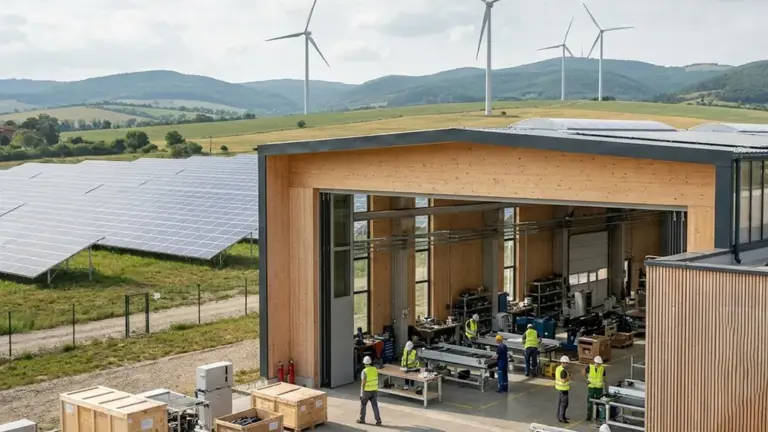
The European Commission has given its nod to a €1b Slovak scheme for cleantech manufacturing capacity in line with the goals of the Clean Industrial Deal. This will help move towards a net-zero economy.
The scheme was approved as per the Clean Industrial Deal State Aid Framework – CISAF that was adopted by the Commission on 25 June 2025.
Slovakia went ahead and notified a €1 billion scheme to the Commission so as to support cleantech manufacturing capacity, thereby contributing towards the objectives of the Clean Industrial Deal under the aegis of CISAF.
This €1b Slovak Scheme for Cleantech Manufacturing is designed to provide adequate production capacity for cleantech. Assistance under the scheme would be in the form of grants and income tax relief. The scheme will be accessible to small and medium-sized enterprises as well as large enterprises making investments that increase the manufacturing capacity for cleantech.
The Commission concluded that the Slovak scheme is compatible with the conditions of the CISAF. Particularly, the aid shall incentivize the production of clean technologies and their primary specific components and associated critical raw materials and could be granted until 31 December 2030.
The Commission found that the Slovak scheme is essential, reasonable, and proportionate to speed up the shift towards a net-zero economy and to foster the establishment of certain economic activities of significance for the execution of the Clean Industrial Deal. This is in accordance with Article 107(3)(c) of the Treaty on the Functioning of the EU as well as the conditions which have been laid down in the CISAF.
On this basis the Commission authorized the aid measure under EU state aid rules.
What is it about?
On 25 June 2025, the Commission adopted the CISAF, which is designed to facilitate support measures in industries that are crucial for the shift to a net-zero economy, in accordance with the Clean Industrial Deal.
The CISAF provides for the following kinds of aid, which can be granted until 31 December 2030 by member states in order to accelerate the clean transition –
Measures to accelerate the absorption of renewable energy and low-carbon fuels (sections 4.1 and 4.2). The member states may establish schemes of investment within all renewable energy sources and energy storage with streamlined tender processes. There are also specific rules to speed up the use of low-carbon fuels.
Measures to offer short-term relief to energy-intensive users from electricity prices so as to facilitate transition to low-cost clean electricity (section 4.5). Such measures will help prevent industrial activities from moving to locations where environmental regulations are missing or less demanding before decarbonization of the electricity system of the EU fully turns into lower electricity prices.
Measures pertaining to decarbonizing industrial processes (section 5). Member states may encourage investments in the decarbonization of industry activities to minimize dependency on imported fossil fuels. This can be accomplished via electrification, energy efficiency and the utilization of renewable and electricity-based hydrogen that meets certain requirements, thereby expanding opportunities to support the decarbonization of industrial processes that switch to hydrogen-derived fuels.
Measures to secure adequate clean technology manufacturing capacity. Member States can provide investment support when it comes to strategic projects that involve batteries, solar panels, heat pumps, wind turbines, electrolysers, carbon capture usage and storage. This also includes the manufacturing of critical components and the production as well as recycling of associated critical raw materials.
Measures to de-risk private investments are needed for the introduction of clean energy, industrial decarbonization, clean tech manufacturing, some energy infrastructure projects and projects promoting a circular economy (section 8).