

Understanding behaviour as communication and teaching new skills
Behaviour is communication. This fundamental principle underlies all effective behavioural approaches to autism. When an autistic person engages in a challenging behaviour whether aggression, self-injury, extreme rigidity, or social withdrawal that behaviour serves a function. It communicates a need, provides sensory input, escapes an overwhelming situation, or achieves a desired outcome. Rather than viewing these behaviours as simply ‘bad’ or ‘wrong,’ behavioural management therapy teaches us to ask: What is this behaviour doing for this person? What underlying need is it meeting? Once we understand the function, we can teach alternative, more adaptive ways to achieve the same goal.
The Core Principle: Function Over Form
Traditional approaches to challenging behaviour often focused on suppression: punishing the behaviour, using time-out, removing the child from the situation. While these strategies might temporarily stop a behaviour, they do not teach the person what to do instead. More importantly, they do not address the underlying need the behaviour is serving.
Modern behavioural approaches work differently. They begin with functional behaviour assessment a careful analysis of what happens before, during, and after the behaviour. What triggers it? What happens as a result? The answers reveal the function: Does the child engage in the behaviour to gain attention? To escape a task? To obtain a sensory experience? To self-soothe when anxious?
Once the function is identified, intervention focuses on teaching replacement skills alternative behaviours that serve the same function but are more acceptable and effective. If a child screams to escape transitions, teaching them to use a visual schedule and a transition warning provides an alternative way to prepare and cope. If a child self-injures for sensory input, offering appropriate proprioceptive activities meets that need differently.
Applied Behaviour Analysis (ABA): The Research Foundation
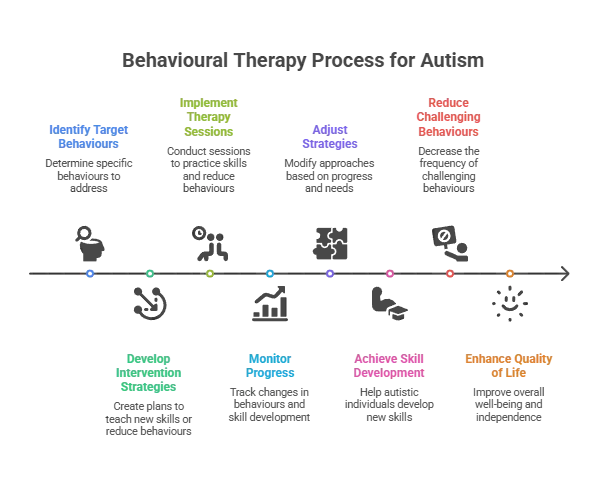 Applied Behaviour Analysis (ABA) is the most extensively researched form of behavioural therapy for autism. ABA uses principles of learning reinforcement, extinction, prompting, and systematic teaching to build new skills and reduce challenging behaviours.
In ABA, learning happens through structured teaching. A skill is broken into small steps. Each step is taught using a clear antecedent (what happens before), behaviour (the response), and consequence (what follows). Correct responses are reinforced (rewarded) consistently, making it more likely the person will repeat them. Over time, complex skills are built from these smaller components.
The quality and philosophy of ABA vary significantly. Early ABA programmes were sometimes criticised for being rigid, compliance-focused, and disconnected from the child’s preferences. Modern, autism-informed ABA is more flexible. It incorporates the child’s interests as reinforcers, respects their autonomy, and teaches skills that are meaningful and functional for their life, not just behaviours that make them easier to manage.
What Behavioural Therapy Can and Cannot Do
Behavioural approaches are powerful for building new skills and reducing specific challenging behaviours. They are particularly effective for:
- Teaching self-care skills (toileting, hygiene, dressing)
- Improving communication and social behaviours
- Reducing challenging or dangerous behaviours by teaching alternatives
- Building work or leisure skills
- Managing anxiety through systematic desensitisation
However, behavioural therapy cannot change the core features of autism. It cannot make an autistic person non-autistic. It cannot eliminate sensory sensitivities, make social communication feel natural, or remove the neurological differences that underlie autism. What it can do is help an autistic person develop skills and reduce distress.
Finding Quality Behavioural Support
If your family is considering behavioural intervention, several factors matter:
- Look for providers trained in current, evidence-based approaches, not just older ABA models
- Ask about the provider’s philosophy: Do they centre the child’s autonomy and interests?
- Ensure assessment and individualisation the programme should be based on this specific child, not a template
- Look for providers who coordinate with other parts of the child’s life (school, family) rather than working in isolation
- Request transparency: You should understand what strategies are being used and why