
When the world is too loud, too bright, too much or not enough
For many autistic children, the world arrives differently. A sound that barely registers for a neurotypical child can be physically painful. A texture that is imperceptible to most is unbearable against the skin. A light that others barely notice flickers with distracting intensity. Or, in the opposite direction: a child who seeks out intense sensory input crashing into furniture, squeezing into small spaces, licking non-food objects because the nervous system is under-responsive and craving more. Sensory differences are now formally recognised in the diagnostic criteria for autism spectrum disorder, and they shape the daily lives of autistic children profoundly from the earliest months of life.
Hyper- and Hypo-Sensitivity
Sensory differences in autism take two primary forms, and both can occur in the same individual even in the same sensory channel at different times:
Hypersensitivity (over-responsivity): the sensory system reacts more intensely than typical. Sounds are louder, lights are brighter, textures are more painful, smells are more overwhelming. The child may cover their ears, shield their eyes, avoid certain fabrics, gag at food smells, or become distressed in environments that most people find unremarkable.
Hyposensitivity (under-responsivity): the sensory system is less reactive than typical. The child may seek intense sensory input crashing, spinning, pressing hard on objects, putting objects in their mouth, appearing not to notice pain or temperature.
Both profiles can cause significant difficulty, and many autistic children present with a complex mixture of both across different senses.
How Sensory Sensitivities Present in Infancy and Toddlerhood
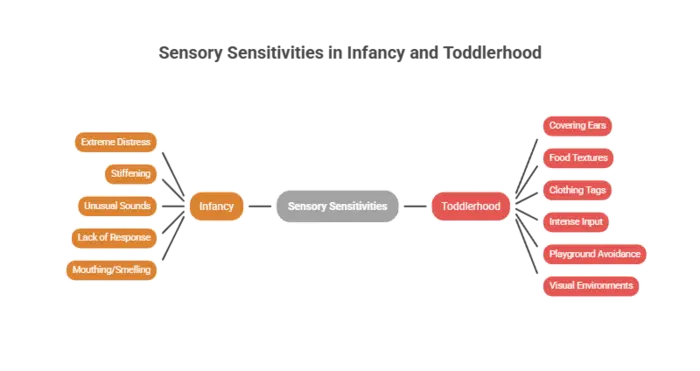 In infants, sensory differences may be visible as:
- Extreme distress when handled, dressed, or bathed
- Stiffening or arching when picked up
- Unusual distress in response to ordinary household sounds
- Apparent lack of response to pain or temperature changes
- Unusual mouthing, smelling, or touching of objects
In toddlers and preschoolers, the picture often becomes clearer:
- Covering ears in response to sounds others do not react to
- Extreme selectivity around food textures not preference, but genuine sensory-driven refusal
- Distress at clothing tags, seams, or specific fabrics
- Seeking out intense physical input (crashing, squeezing, pressure-seeking)
- Avoiding playground equipment that involves movement, balance, or vestibular input
- Distress in brightly lit or visually ‘busy’ environments
Sensory Processing and Daily Functioning
Sensory sensitivities in early childhood are not simply inconvenient they can profoundly shape a child’s daily life. Mealtimes become battles over texture. Getting dressed is a source of daily distress. A school trip to the swimming pool becomes overwhelming. A birthday party with its noise, lights, and unpredictable social demands can trigger a full meltdown.
Parents who seek support for their child’s ‘extreme fussiness’, ‘sensory meltdowns’, or ‘unusual eating’ may be witnessing sensory processing differences that are highly relevant to an autism assessment.
Occupational Therapy and Sensory Support
Sensory integration therapy typically delivered by occupational therapists trained in sensory processing is one of the most commonly used approaches for addressing sensory differences in autistic children. While the evidence base is still developing, many families report meaningful improvements in daily functioning following sensory-based OT.
Practical adaptations sensory-friendly clothing, noise-cancelling headphones, dimmer switches, weighted blankets, designated quiet spaces can make an enormous practical difference to a child’s quality of life while longer-term support is developed.
Conclusion
Sensory sensitivities are one of the most pervasive and life-affecting aspects of autism across the lifespan and they are present from the earliest months of life. Recognising them, taking them seriously, and building environments and routines that accommodate them is not a soft option. It is the foundation of a daily life in which an autistic child can actually learn, connect, and thrive.