

When change is not just disliked it is devastating
Many toddlers dislike disruption. A changed bedtime, an unexpected detour, a different cup than usual these can trigger protests in neurotypical children too. But in autism, insistence on sameness goes beyond a preference for routine. It is a deep, neurologically driven need for the world to be predictable, consistent, and repeatable and when that predictability is disrupted, the distress is not simply disappointment. It can be profound, overwhelming, and completely disproportionate to the apparent scale of the change.
What Insistence on Sameness Looks Like
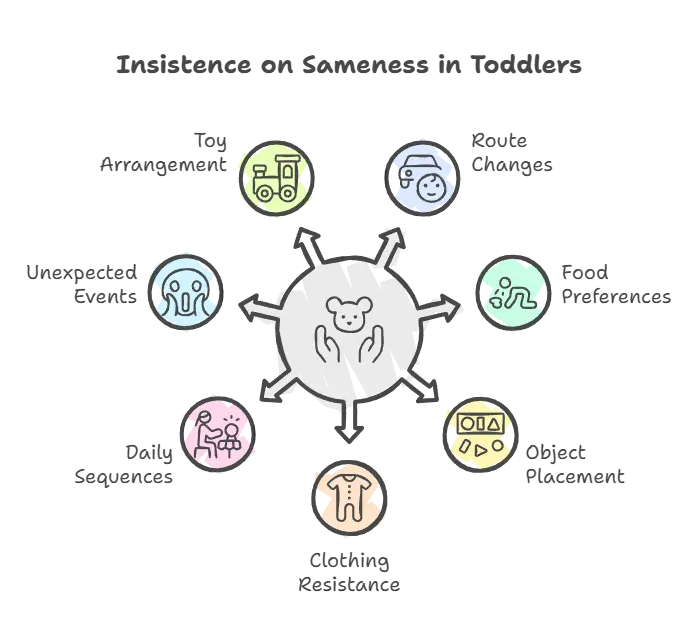 Insistence on sameness (also called intolerance of uncertainty or rigidity) presents in a wide variety of forms in toddlers and preschoolers:
- Extreme distress when a familiar route is changed
- Insistence on eating from the same plate, with the same utensils
- Needing objects placed in exactly the same position
- Resistance to wearing different clothes, particularly if textures differ
- Rigid daily sequences that must be followed precisely
- Intense reaction to the unexpected: a substitute teacher, a moved piece of furniture, a rearranged room
- Lining up toys or objects and becoming distressed if they are moved
The key feature is the severity and consistency of the distress and the child’s apparent inability to be talked out of it or comforted through it in the ordinary way.
Why Predictability Matters So Much in Autism
Current neuroscientific accounts of autism suggest that the autistic brain may process uncertainty differently. In predictive processing frameworks, the brain constantly generates predictions about what will happen next and updates those predictions based on incoming sensory information. In autism, this system may be calibrated differently with a stronger reliance on existing predictions and a more intense response when they are violated.
This means that unexpected change is not just inconvenient it triggers a genuine neurological alarm response. The child is not being deliberately difficult. They are experiencing real distress in response to a world that has become suddenly unpredictable and therefore threatening.
Rigid Routines as Coping
Insistence on sameness can be understood, in part, as a coping strategy. In a world that is often confusing, socially unpredictable, and sensorially overwhelming, routine provides a reliable framework. If I know exactly what will happen next, I can manage. If that known sequence is disrupted, the scaffolding falls.
This is why insistence on sameness often intensifies during periods of heightened stress starting school, illness, family disruption and may reduce when the child’s overall anxiety is well managed.
Supporting a Child Who Needs Predictability
Use visual schedules pictures or symbols representing the sequence of the day
- Give advance warning of changes: ‘In five minutes we are going to change this’
- Introduce change gradually and with support, rather than abruptly
- Avoid unnecessary unpredictability when it can easily be prevented
- When a meltdown occurs over a change, recognise it as a distress response — not a behaviour to be punished
- Work with an occupational therapist or psychologist experienced in autism to build flexible coping skills gradually over time
Conclusion
Insistence on sameness is one of the most disabling aspects of autism for many children and their families not because it is intrinsically problematic, but because the world is inherently unpredictable and change is unavoidable. Understanding it as a neurologically driven need rather than a behaviour choice transforms how parents and educators respond and opens the door to genuinely supportive strategies that build flexibility with safety rather than forcing compliance with stress.