

When the body finds its own rhythm
Hand-flapping when excited. Rocking back and forth during a stressful wait. Spinning in circles with intense focus and apparent delight. These are some of the most recognisable and most misunderstood behaviours associated with autism. Known as stimming (short for self-stimulatory behaviour), repetitive motor behaviours are a core feature of autism spectrum disorder and one of the two diagnostic domains required for a clinical diagnosis. Understanding what stimming is, why it happens, and what purpose it serves is essential for anyone raising, teaching, or supporting an autistic child.
What Stimming Is
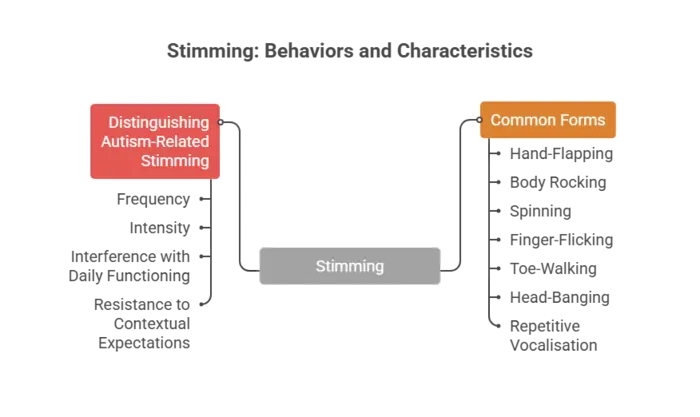 Stimming refers to repetitive, self-directed motor behaviours that provide sensory feedback to the person performing them. Common forms in early childhood include:
- Hand-flapping typically when excited, happy, or overwhelmed
- Body rocking often a calming, self-regulating behaviour
- Spinning either the body itself or objects
- Finger-flicking in front of the eyes
- Toe-walking and repetitive jumping
- Head-banging in some cases, particularly when dysregulated
- Repetitive vocalisation humming, clicking, or repeating sounds
It is worth noting that stimming is not exclusive to autism. Many people stim — leg bouncing, hair twirling, nail biting, pen clicking are all forms of stimming in the broader sense. What distinguishes autism-related stimming is its frequency, intensity, the degree to which it interferes with daily functioning, and its resistance to contextual expectations.
Why Autistic People Stim
Stimming serves multiple functions, and these functions matter for how it should be approached. Research and autistic self-report literature have identified several key purposes:
Sensory regulation: many autistic people experience the world with more intense or differently calibrated sensory perception. Stimming helps modulate sensory input dampening overwhelm or increasing stimulation when the environment is under-stimulating.
Emotional regulation: stimming often intensifies during emotional arousal both positive (excitement) and negative (distress). It is a way the nervous system self-regulates.
Communication: some stimming behaviours signal emotional states to those who know the child well. Increased hand-flapping may reliably indicate excitement or anxiety depending on context.
Pleasure and enjoyment: some stimming is simply pleasurable. The autistic brain may derive sensory satisfaction from repetitive movement in a way that is intrinsically rewarding.
When Stimming Appears in Early Development
Stimming behaviours typically become visible in the toddler and preschool years, though some unusual repetitive movements may be observable in infancy. Between twelve and thirty-six months, a child who hand-flaps frequently, rocks during play, or spins objects with unusual intensity and duration may be demonstrating one of the diagnostic markers of autism.
The context matters: stimming that occurs only in response to a specific trigger (such as spinning the wheels of a toy car exclusively) versus stimming that occurs across many settings and in response to varied emotional states presents differently in clinical evaluation.
Should Stimming Be Stopped?
This is one of the most debated questions in autism practice. Historically, behavioural approaches that suppressed stimming were common. The contemporary view supported by autistic advocates, researchers, and a growing body of clinical guidance is that stimming should generally not be suppressed when it serves a regulatory function and does not cause harm.
Suppressing stimming does not remove the underlying need it serves; it removes the child’s way of meeting that need. The energy and focus required to suppress a natural self-regulatory behaviour takes a significant toll on the child’s cognitive and emotional resources.
Stimming that causes physical harm (head-banging against hard surfaces, for example) warrants support not to eliminate it, but to identify and address the underlying need and find safer alternatives.
Conclusion
Repetitive motor behaviours are not random, purposeless, or something to be embarrassed about. They are a sophisticated if non-typical way that the autistic nervous system manages sensory experience, regulates emotion, and finds pleasure. Understanding stimming on its own terms, rather than through the lens of how it appears to others, is fundamental to supporting autistic children with respect and genuine understanding.