
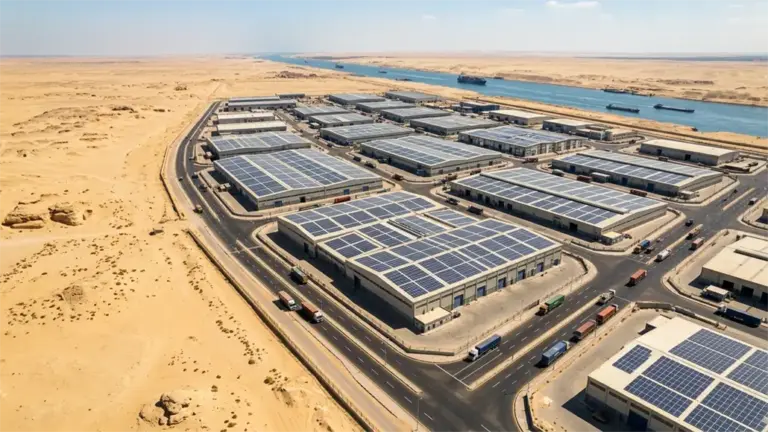
Khaled Hashem, the minister of industry in Egypt, hosted a steering committee meeting of the Egypt Country Partnership Programme – PCP, which is carried out in collaboration with the United Nations Industrial Development Organization – UNIDO so as to review the advancement of the programme and talk about potential industrial development projects in Egypt.
The meeting was attended by Patrick Jean Gilabert, UNIDO Regional Director in Egypt, Jehan Bayoumi, UNIDO Deputy Regional Director, Walid Gamal El-Din, Chairperson of the General Authority for the Suez Canal Economic Zone as well as representatives of relevant ministries and government bodies along with development partners.
The participants summed up the execution of the programme and pointed out the major achievements in the industrial development projects in Egypt throughout the past period.
The six major pillars of the programme were also talked about, which were essentially industrial policy and governance, investment promotion, green manufacturing in Egypt, smart cities along with sustainable industrial zones, value chain development and adaptation to the Fourth Industrial Revolution.
Apparently, the meeting further discussed future action plans in order to accelerate inclusive industrial growth in accordance with Egypt Vision 2030 and also the national strategy for industrial development along with export growth, as well as boosting the competitive edge of Egyptian products alongside increasing access to global markets.
According to Hashem, the Egypt Country Partnership Programme is an important collaborator in assisting the efforts by the government to accomplish a significant industrial and production change, pointing out the fact that its projects link up with numerous industries to promote innovation and enhance workforce capacity within the Egyptian factories.
He added that the program also helps to develop a more favourable investment climate and reinforces public-private partnerships.
The minister said that the projects carried out under the programme are in line with the broader strategy of the Ministry of Industry in order to promote Egyptian manufacturing, pointing out the technical assistance offered by UNIDO via data and analytical instruments enabling the policymakers to evaluate growth and quantify results.
Hashem deemed the partnership an effective model of international cooperation for achieving the goals of the ministry and emphasised the Egyptian government’s commitment to providing UNIDO with the necessary support along with facilitation in order to execute its projects across Egypt.
It is worth noting that such initiatives are assisting to localise advanced industries and strengthen Egypt’s status as a regional center for sustainable manufacturing as well as exports, Hashim said.
Separately, Hashem met with Gilabert for bilateral talks in order to discuss the ongoing and future projects by UNIDO in Egypt. The assistant minister for international cooperation, Ahmed Maghawry, and the assistant minister for energy affairs, Hussein El-Ghazawy, were also present at the meeting.
The discussions also reviewed multiple ongoing UNIDO projects related to the green manufacturing in Egypt at the local level, energy efficiency programmes, transition to clean energy initiatives within industrial zones and industrial waste management systems so as to foster the circular economy.
Hashem highlighted the significance of energy-efficiency projects, in particular those that are related to water conservation. The fact is that the awareness of renewable energy is increasing within the industrial sector, but there is a demand for more focus on effective utilisation of water within industrial processes, as water is paramount for many key industries, he said.
He said factories could save money and support wider environmental objectives by lowering water consumption and waste.
Gilabert, in his part, lauded the ongoing partnership between UNIDO and the Egyptian government, as well as the organisation’s concentration on assisting national endeavours to establish domestic industrial capacities.
Interestingly, UNIDO’s present portfolio of 23 projects in Egypt is the largest in the world and provides technical assistance to local industrial plants in areas such as energy efficiency and green transformation as well as industrial development, he said.
Gilabert said that many international partners, such as the European Union, the Global Environment Facility, the Green Climate Fund, and the governments of Switzerland, Italy, Canada, Japan, and Germany, are funding these efforts. He added that arrangements are in progress to initiate nine more projects in the forthcoming period.